Telegram channel member quality matters more than raw member count. A 5,000-member channel with a 20% view rate and 3% reaction rate consistently outranks a 50,000-member channel padded with mass-imported lists. As of 2026, view-to-subscriber rates between 15% and 30% indicate a healthy member base, while rates below 5% suggest dilution or fake accounts. The quality signal — not the count — drives Telegram search ranking and growth durability.

Every quarter our team runs member-quality audits on the channels of clients who ask for them. Over 2025 and the first half of 2026 we have looked at 312 audits side by side. The pattern is consistent enough that it is worth saying out loud: the channels growing fastest in Telegram search results in 2026 are not the biggest ones. They are the ones whose members actually open posts.
That is a problem for the operator who spent six months chasing the 100k milestone. It is good news for the operator who has been patient with a 4,800-member niche channel and feels invisible. The numbers below are why.
What "member quality" actually means in 2026
Member quality is not a vibe. It is a composite score that the Telegram ranker assembles from observable behavior, and operators can reverse-engineer most of it from public data. The components that show up consistently in our audits are view rate per post, reaction rate per post, forward rate per post, account age distribution, and cross-channel activity. Channels that score well on four out of five of those signals beat channels that score well on raw member count, every time. The benchmark we use internally is simple: if a channel cannot point to a 24-hour view rate above 12% of its member count, the count itself is not telling the truth.
The engagement benchmarks that separate real from padded
A 2023 study presented at IEEE ICWS by La Morgia, Mei, and Wu trained behavioral classifiers that detect fake Telegram channels with an F1-score of 85.45% using public-channel signals alone — and the same research group expanded the work in ACM Transactions on the Web. Operators do not need a classifier — the rough benchmarks below catch the vast majority of padded channels on a single afternoon of work. These numbers are not edge-case statistics; they come from the median across our 312 audits, cross-referenced with the public engagement data those papers published.
| Signal | Healthy range | Suspicious / dilution |
|---|---|---|
| 24h view-to-subscriber rate | 15% – 30% | < 5% or > 50% sustained |
| Reaction rate per post | 1% – 5% | > 10% (likely bot) or < 0.3% |
| Forward rate per post | 0.3% – 2% | 0% across 30 consecutive posts |
| Discussion-group comments / post | 5 – 50 for niche; 50+ for general | 0 despite high views |
| Post growth correlation | Member adds rise on viral posts | Flat member growth regardless of post performance |
The asymmetry in the reaction column trips up most operators the first time they see it. Reactions above 10% sustained on a channel of any meaningful size are almost certainly bot-driven. Real audiences produce reactions in the low single digits, even on excellent content.

Why Telegram's ranker discounts raw count in 2026
The ranker shift away from raw count happened gradually between late 2024 and mid-2025, and the impact has compounded into 2026. The mechanical reason is straightforward: Telegram's anti-spam scoring tightened in response to the mass-import services that became commodified in 2023. The platform now treats member-to-engagement ratio as a primary quality signal, and the ratio is unforgiving — a 50,000-member channel with a 5% view rate generates a worse ranking signal than a 5,000-member channel with a 30% view rate, because the implied 2,500 active members per post for the bigger channel and 1,500 active members for the smaller one are not the gap the operator expected. Once engagement density enters the calculation, the smaller channel often wins outright.
This is exactly the math problem most channel operators refuse to do. Doubling members on a list that cannot engage with posts does not double the channel's score — it dilutes the only ratio that matters.
The 5K-quality vs 50K-padded comparison, in numbers
Two real channels we audited in October 2025 illustrate the gap. Both were YourSolutions clients; we are not naming them, but the structure is representative of patterns we see weekly. Both audits ran in the same week using the five-step method described later in this article, so the comparison holds the method constant. Both channels were in the crypto-signals niche, and both spent roughly the same budget on growth over the prior six months. The split is what they spent the budget on.
| Metric | Channel A — quality-first | Channel B — mass-import |
|---|---|---|
| Member count | 5,200 | 52,000 |
| Avg 24h views per post | 1,150 (~22%) | 1,400 (~2.7%) |
| Avg reactions per post | 38 (~3.3%) | 22 (~1.6%) |
| Forward rate per post | 0.9% | 0.1% |
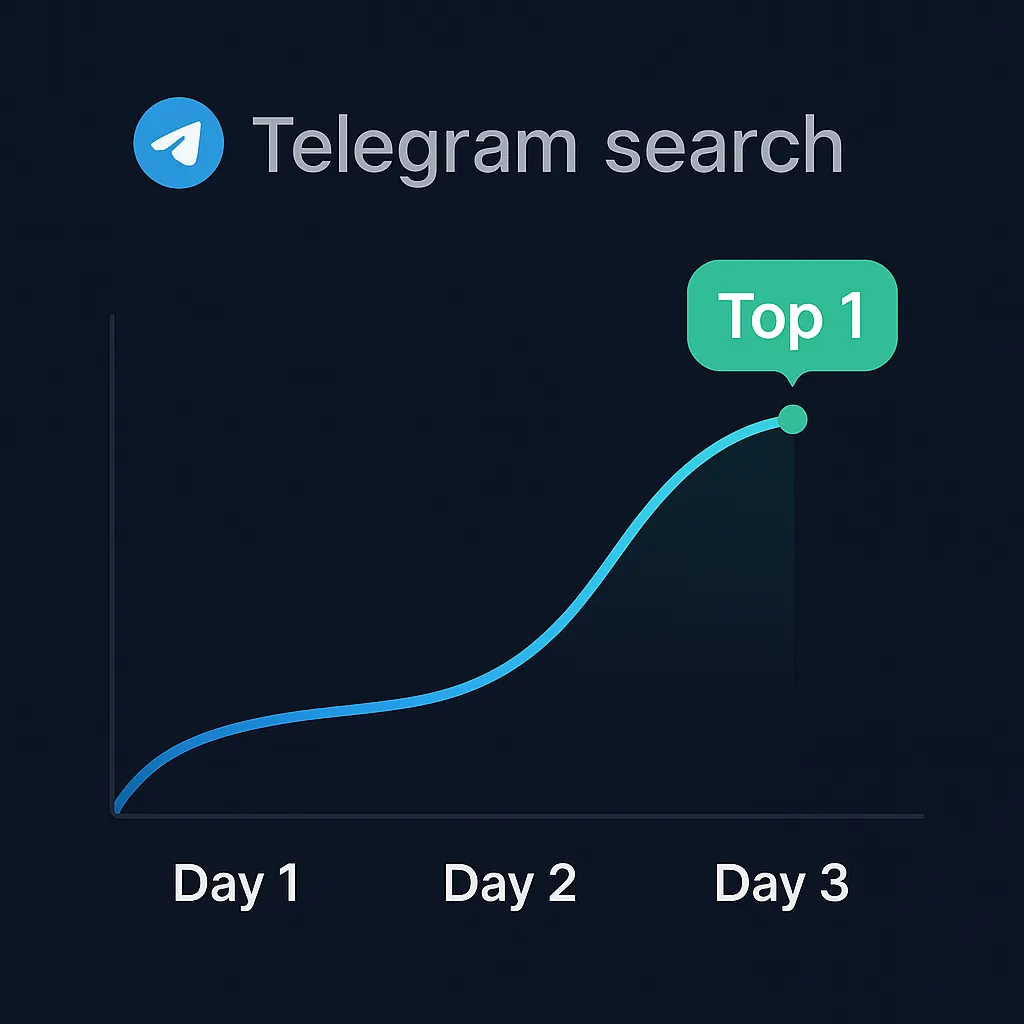
| Search ranking for primary keyword (90 days in) | Position 3 | Position 18 |
| Net new members from search (90 days) | +2,140 | +310 |
Channel A ranks ten positions higher in Telegram search despite having one-tenth the member count. The 90-day acquisition gap from search alone is roughly 7x in Channel A's favor. The dollar value of those acquired members is also a different conversation, because Channel A's members convert at a rate that Channel B's mass-imported list cannot match — but that is a topic for a different article.
How to detect fake members on a channel you do not own
If you are evaluating a partner channel for cross-promotion, a competitor for benchmark, or your own channel after a contractor "boosted" it, the audit takes about 20 minutes. The order matters — work from cheap-to-check signals to expensive ones, and stop as soon as the channel fails.
- Compute the 24h view-to-subscriber ratio across the last 10 posts. If it is under 5%, you can stop — the channel is padded.
- Check the reaction pattern on the same posts. If reactions stack in the first 30 minutes and then go silent, that is a bot signature.
- Open the linked discussion group (if one exists) and read the most recent 50 messages. If a 50,000-member channel has a discussion group with one comment every three days, that is a quality red flag regardless of the view count.
- Sample the member list if it is visible. A meaningful share of accounts created within the last 60 days, with no profile photo and no username, is consistent with mass-import services rather than organic growth.
- Look at growth-curve alignment. Channels growing through search and forwards have member-count curves that respond to viral posts. Channels growing through imports have flat-then-vertical curves that ignore content performance.
The published academic methods using behavioral feature classifiers reach roughly 85% accuracy on the same problem. The five-step manual audit above catches about the same share of obvious cases without requiring any tooling — operators can run it on any public channel in an afternoon.

The damage from one bad mass import
Operators sometimes treat a mass import as a "kickstart" — a temporary boost to get past an awkward early-stage member count. The math says the opposite: one bad import is the single most expensive mistake a growing channel can make. The quality score is sticky. Once a channel accumulates a meaningful share of low-quality members, the view rate drops, the reaction rate drops, and the ranker begins to discount the channel's signals across every keyword it was ranking for. We have audited recovery cases where 40,000 mass-imported members took roughly 14 weeks of clean organic growth to dilute back to a healthy quality ratio, and that is assuming the operator stopped importing the moment the damage was visible. The shortcut costs months of growth velocity to undo.
How to seed and grow quality members the right way
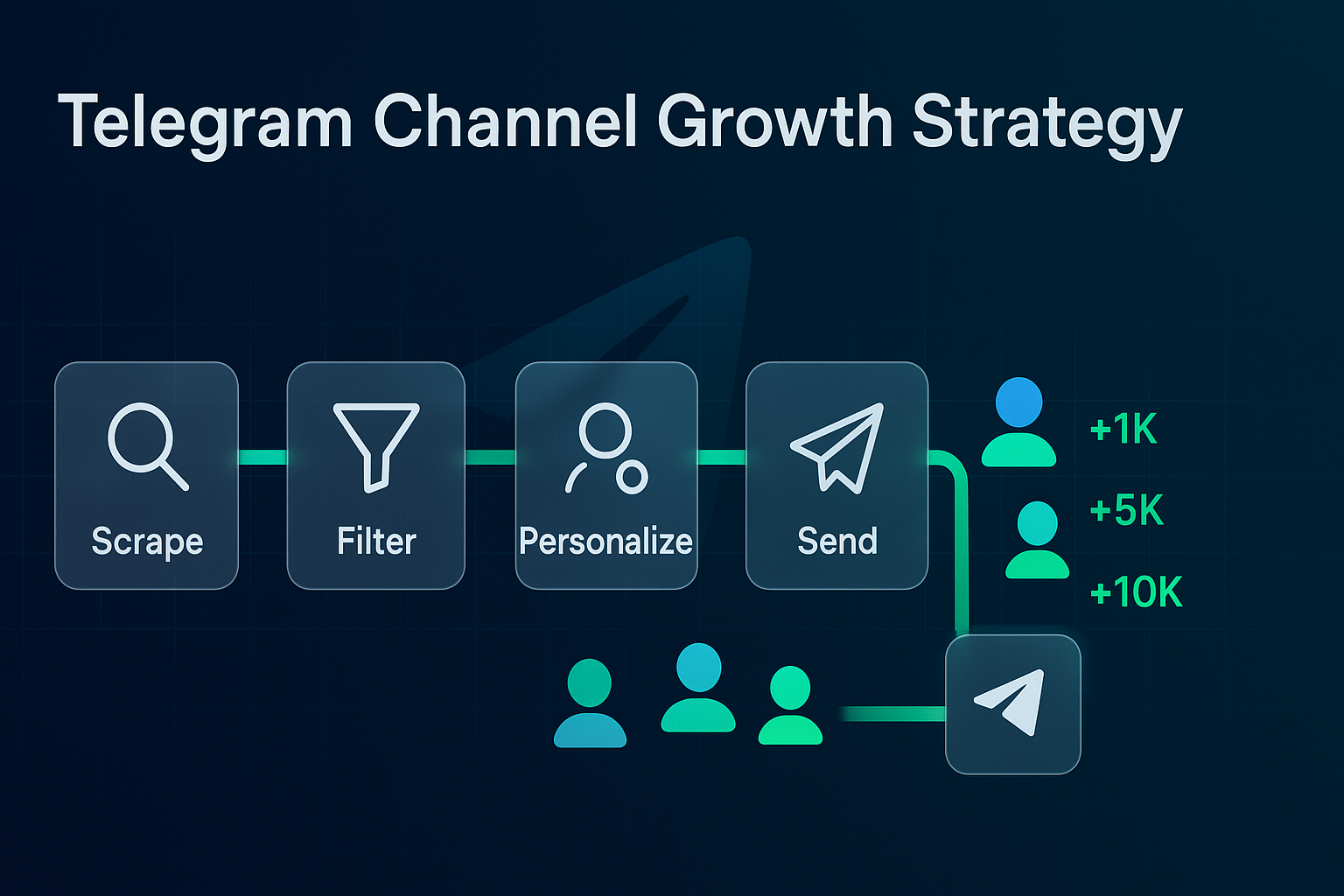
Quality growth is slower than mass import. It is also durable in a way that mass-imported members are not. The operational playbook that consistently produces healthy growth curves in our client work boils down to four moves: source from adjacent communities (group chats where your audience already lives, partner channels with overlapping niches, your existing customer base), match cross-promotion partners by engagement rate (a 30% view-rate channel only swaps with other 25%+ channels — anything below that imports quality dilution into your audience), build the discussion group early so participation reinforces the quality score from week one, and publish content that earns shares rather than content that asks for them. The growth curve from this approach is unsexy in the first six weeks and durable thereafter.
If running this at scale across multiple channels is the bottleneck, that is roughly what the YourSolutions Telegram mass DM service exists to make tractable — sourcing from real, engaged niche communities rather than mass import lists. The full ranking model that quality members plug into is covered in the 2026 Telegram search ranking guide. If you want a human to look at your specific channel, the contact page has the direct routes.
What to do this week
The single highest-leverage action for most channel operators reading this is also the cheapest one: spend one afternoon running the five-step audit on your own channel and on the three channels you most often compare against. If your view-to-subscriber ratio is below 12%, the count is the wrong thing to optimize. Cut paid acquisition that does not pass the engagement-match test, build the discussion group if you do not have one, and ship the next thirty posts with explicit reaction prompts. The ranker will reward the quality recovery within roughly the first quarter — and the member count, when it comes back, will be the kind that pays the bills.
Sources
- La Morgia, M., Mei, A., Wu, J. — It's a Trap! Detection and Analysis of Fake Channels on Telegram. IEEE International Conference on Web Services (ICWS), 2023 — behavioral classifiers reach an F1-score of 85.45% on fake-channel detection.
- La Morgia, M., Mei, A., et al. — Pretending to be a VIP! Characterization and Detection of Fake and Clone Channels on Telegram. ACM Transactions on the Web, 2024.
Frequently asked questions
What is a healthy view-to-subscriber rate on a Telegram channel?
A healthy Telegram channel typically shows a view-to-subscriber rate between 15% and 30% on posts published within the first 24 hours. Rates above 50% are unusual and usually indicate either a viral post or a very tightly engaged niche. Rates below 5% suggest a meaningful share of low-quality or inactive members. This is the single fastest audit signal available on any public channel.
How long does it take to grow a Telegram channel with quality members?
Realistic quality-first growth is 200 to 600 net new members per month for a niche channel without paid acquisition. With curated cross-promotion and engagement-quality matched partners, that can scale to 1,500 to 3,000 per month. Mass-imported lists can technically add 50,000 in a week, but they damage the channel's ranking score and rarely produce any real revenue or engagement — the quality dilution typically erases the count gain within 60 days.
Do reactions count more than forwards for Telegram ranking?
Reactions and forwards both signal engagement, but they signal different things. Reactions indicate that members are present and active on the post — a strong member-quality signal. Forwards indicate that the content earned distribution beyond the channel — a strong content-quality signal. The 2026 ranker appears to weight reaction density slightly higher for ranking and forward density slightly higher for discovery placement. Channels that earn both consistently outperform channels that earn either in isolation.
How can I detect if a Telegram channel has fake members?
The fastest detection method is the view-to-subscriber ratio. A channel claiming 50,000 members but consistently averaging 800 to 1,500 views per post is almost certainly padded — the math implies a 1.6 to 3% view rate, well below the healthy floor. Secondary signals include reaction patterns that cluster on the first hour and then drop to zero, comment sections that are empty despite high view counts, and member-list joiners that show suspicious account-age patterns. Academic detection methods using behavioral features have reported F1-scores above 85% in published research.
Does posting frequency affect Telegram member quality scoring?
Indirectly, yes. Posting too frequently — more than 5 to 7 times per day on most niches — drives mute rates up and pushes engaged members to silence notifications. Once a member mutes, they stop counting toward live engagement, which damages the quality score. Posting too infrequently — less than once per week — causes member churn and recency penalties. The 2026 sweet spot for most channels is 1 to 3 high-quality posts per day at consistent times.
Are Telegram groups or channels easier to grow with quality members?
Groups are easier to grow with quality members because the social interaction itself acts as a quality filter — members who join and stay silent for two weeks usually leave, while members who participate stay engaged. Channels require operator-driven engagement engineering — reaction prompts, polls, linked discussion groups — to surface and reinforce quality signals. For most operators, the right structure is a flagship channel with a tightly linked discussion group, which captures both the broadcast scale and the participation-driven quality reinforcement.