Talk through a Telegram channel ranking campaign
Telegram channel ranking is where your channel, bot, or group lands in Telegram's in-app search for a given keyword. Telegram's ranker weighs username and title relevance, member and Premium-subscriber quality, engagement density, posting velocity, and how recently the entity was active. A Telegram channel ranking service tunes those signals deliberately. YourSolutions runs the campaign and reports ranking movement with dated search screenshots.
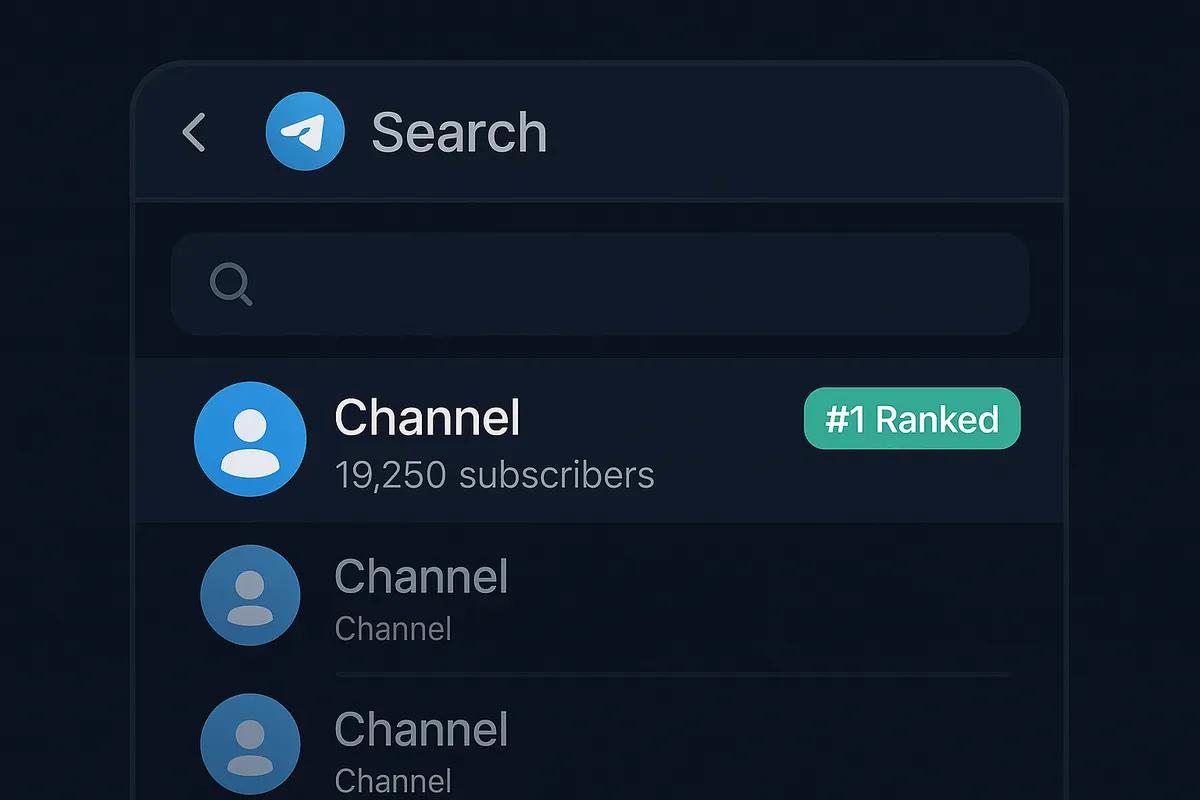
Type a keyword into Telegram's search bar and you get a ranked list: ten or so channels, bots, and groups, ordered by an algorithm Telegram has never published. For most niches that list now drives more first-time discovery than forwarding chains do. We've watched channels go from invisible to top-three on a target keyword and pull 40–60% of their new joins from search alone within a quarter.
But ranking in that list isn't luck, and it isn't member count. It's a set of signals — and most of them are the opposite of what channel owners spend money on. This page covers what Telegram channel ranking actually depends on, how a YourSolutions campaign moves those signals week by week, how channels, bots, and groups differ, and what it costs.
What is Telegram channel ranking?
Telegram channel ranking is the position your channel, bot, or group occupies in Telegram's in-app search results for a specific keyword. When someone types "crypto signals" or "nft drops" into the search bar, Telegram returns a ranked list, and where you land on it is your ranking. It is not the same as the public leaderboards run by directories like TGStat or Telemetrio — those sort by raw subscriber count and live outside the app. In-app ranking is what a real prospective member sees at the moment they're looking for a channel like yours. Telegram has never documented the algorithm behind it, so everything practical about Telegram ranking comes from controlled testing: change one signal, hold the rest, watch the position move. That's the method behind everything on this page, and it's why the advice here is narrower than the usual listicle.
Your username is the anchor. Telegram's own writeup on public usernames is blunt about it — a public username is what makes a channel "possible for other users to find" you in global search. Everything else — engagement, members, cadence — modifies a ranking that the username makes possible in the first place. Get the username wrong and no amount of engineering the other signals fully compensates.
The signals Telegram's search ranker actually weighs
Telegram's search ranker reads at least six signals, and they don't carry equal weight. Username and title keyword relevance comes first — an exact-match username wins its keyword almost by default, and for bots the visible title matters more than the @handle. Member quality comes next, and in 2026 it's dominated by Telegram Premium subscribers. Since Telegram's August 2024 ranking update, Premium members — especially Premium members in your target country — pull far more weight than ordinary subscribers. Then engagement density: views, reactions, and replies per post, normalized against member count. Then posting velocity and consistency. Then recency — Telegram's own peer-rating documentation describes a system that decays the score of anything you haven't interacted with lately. Raw member count, the thing most owners obsess over, is the weakest of the six.
With multiple Telegram channels ranking for the same query, position comes down to those six signals — and the table below is how we weight them going into a campaign. It's the same signal model laid out in our 2026 Telegram search ranking guide, sharpened by what's shifted since.
| Signal | What Telegram reads | Weight in 2026 | What actually moves it |
|---|---|---|---|
| Username & title relevance | Keyword match in @username (channels, groups) or visible title (bots) | Highest | Chosen once, before launch — hardest to fix later |
| Premium member quality | Share of Telegram Premium subscribers, weighted by country | High, rising since Aug 2024 | Seeding real Premium members from the target region |
| Engagement density | Views, reactions, replies per post ÷ member count | High | Content that earns reactions; prompts, polls, a discussion group |
| Posting velocity | Cadence and consistency of posts, or bot "Start" events | Medium | A fixed daily schedule, held for 90 days |
| Recency | How recently the entity saw real activity | Medium | Never going dark — 30+ days silent tanks the score |
| Raw member count | Total subscribers, ignoring quality | Lowest | Largely a vanity metric the ranker discounts |
Read that table top to bottom and the pattern is hard to miss: the signals you can buy cheaply — raw members — are the ones Telegram discounts, and the signals that take real work are the ones it rewards. We've ranked channels with 4,000 members above competitors with 60,000, because the smaller channel had a 35% view rate and a feed of real reactions while the big one was a graveyard of imported accounts. If you want the longer version of why that gap exists, our breakdown of Telegram channel member quality covers the member-quality side in depth.
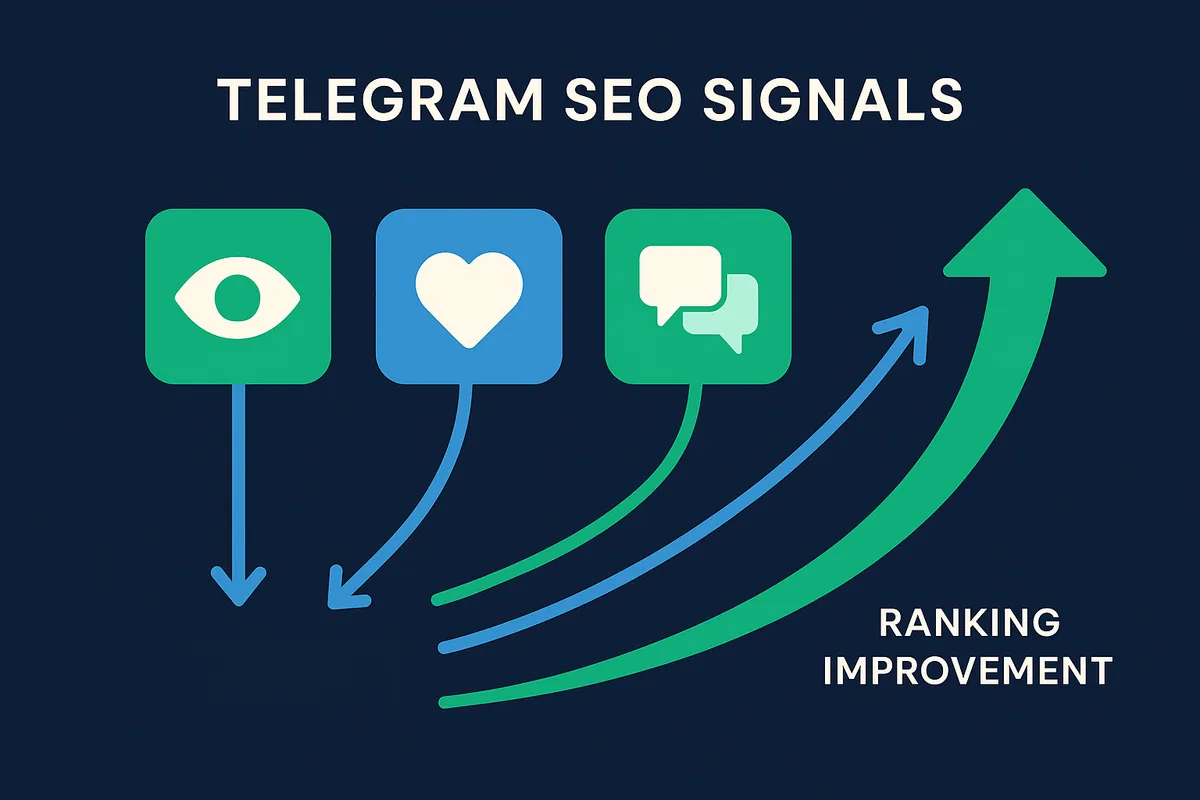
How to rank a Telegram channel, week by week
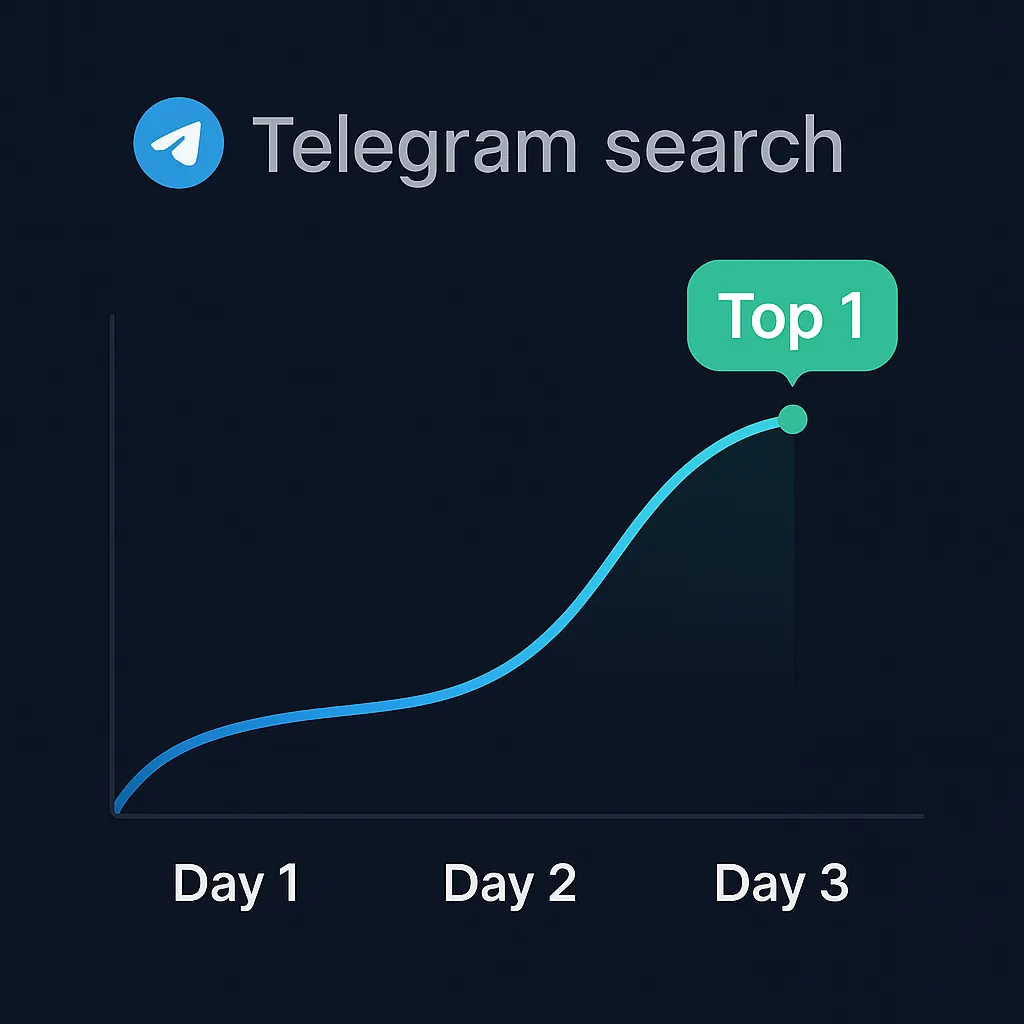
Plenty of advice exists on how to rank Telegram channel keywords, and most of it stops at the username. Knowing how to rank a Telegram channel is really a sequencing problem — the signals have to be built in the right order, because some compound and some can't be rushed. A YourSolutions campaign runs in four stages across roughly a quarter. Stage one is the audit: we check the username against the keyword you want, map the competing channels already ranking for it, and fix what's fixable. Stage two is seeding — real, Premium-weighted members sourced from communities adjacent to your niche, not bulk-imported lists. Stage three is engagement: posting cadence locked to a daily schedule, reaction prompts and a linked discussion group switched on, bot Start events paced if the entity is a bot. Stage four is measurement, running the whole time — dated search-position screenshots tracking the keyword and your Telegram channel rank week over week. Most low-competition keywords move inside two to three weeks; competitive ones take 60 to 120 days.
The sequencing below is the same one our team runs internally, and it expands on the playbook in the search ranking guide linked above.
- Week 1 — Audit and username fix. Keyword-to-username check, competitor mapping, and any one-time username or bot-title correction while it's still cheap to make.
- Weeks 1–3 — Premium-weighted seeding. Real members sourced from adjacent communities, weighted toward Telegram Premium accounts in the target country.
- Weeks 2–12 — Engagement and cadence engineering. Daily posting schedule held without gaps, reaction prompts and a linked discussion group running, bot activations paced.
- Throughout — Ranking evidence reports. Dated search-position screenshots on a fixed cadence, so the movement is measured, not asserted.
Channels, bots, and groups don't rank the same way
Telegram channel ranking, Telegram bot ranking, and Telegram group ranking share a ranker but not a playbook — each entity exposes different signals. Channels are the cleanest case: username, posting cadence, and view-rate engagement carry the campaign. Bots change the rules — Telegram leans on the bot's visible title rather than its @username, and the engagement signal becomes Start events and repeat opens instead of post views, so a bot campaign optimizes the title and the activation flow. Groups add a signal channels can't touch: the owner account's phone-number country influences which country's search results the group surfaces in. And live in-language conversation counts as engagement in a way broadcast posts don't. So a Telegram group ranking campaign weights regional setup and chat activity; a bot campaign weights title and activations; a channel campaign weights cadence and reactions. Same ranker, three different levers.
| Entity | Ranker leans on | Engagement is | Campaign priority |
|---|---|---|---|
| Channel | @username keyword match | Views and reactions per post | Cadence + reaction engineering |
| Bot | Visible title keywords | Start events and repeat opens | Title + activation-flow tuning |
| Group | @username plus owner-account country | Live in-language messages | Regional setup + chat seeding |
Tell us which of the three you're ranking and the campaign is scoped to that lever — there's no generic "Telegram package" that pretends a bot and a group are the same problem.
DIY Telegram ranking bot vs. a managed service: which is worth it?
Search "telegram ranking bot" and you'll find scripts and gig listings promising to automate the whole thing — point a bot at your channel, feed it members and fake views, watch the rank climb. The mechanics aren't fake; cheap engagement does register, briefly. The problem is what registers next. Telegram's ranker measures member quality and engagement authenticity. So a flood of bot-grade members and hollow views moves the position up for days, then sinks it below where it started — the channel's quality score is now poisoned. A DIY telegram ranking bot also can't source Premium members, can't run the regional setup a group needs, and can't read the keyword landscape. A managed service is slower on purpose — real members, real engagement, real cadence — because that's the only version of Telegram ranking that holds once the index recalculates. The comparison below is the honest one.
| Factor | DIY ranking bot / script | Managed YourSolutions campaign |
|---|---|---|
| Member source | Bot-grade or recycled accounts | Real, Premium-weighted, region-matched |
| Engagement | Fake views, hollow reactions | Earned reactions, real discussion |
| Lifespan of the rank | Days — sinks when the index recalculates | Holds across recalculation cycles |
| Bot and group support | Channels only, usually | Channels, bots, and groups |
| Keyword strategy | None — you guess | Mapped against live search competition |
| Risk to the entity | Quality-score poisoning, possible limits | Engineered to stay inside normal patterns |
| What you see | Console logs | Dated ranking-evidence screenshots |
What does a Telegram channel ranking campaign cost?
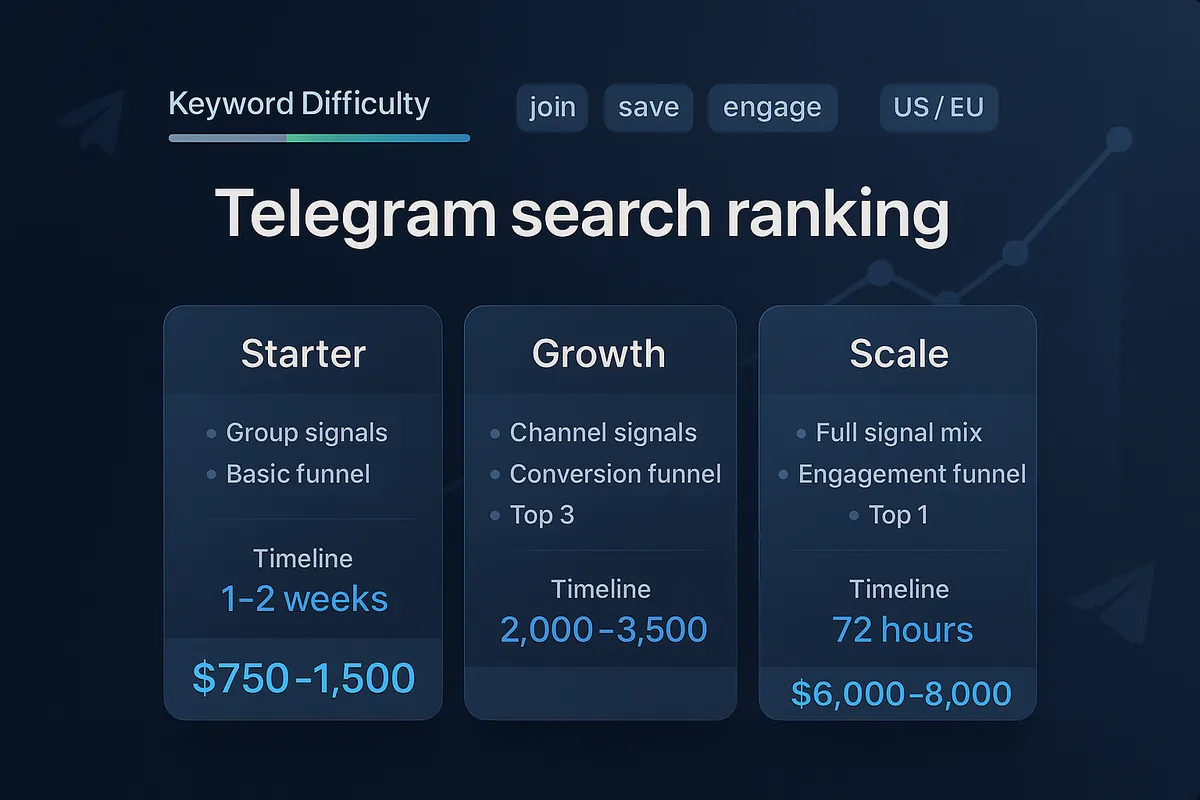
Pricing for Telegram channel ranking has a visible market floor. Based on our Q2 2026 review of SMM panels and Telegram-native sellers, pay-per-keyword listings tend to start around 50 to 150 US dollars per keyword for a single channel. For competitive terms, the number climbs fast. We won't pretend a managed campaign is the same product as a panel order, because it isn't, and the price reflects that. A YourSolutions campaign is scoped before it starts against three variables: how competitive the target keyword is, which entity type you're ranking (a group needs regional setup a channel doesn't), and how much member seeding the gap demands. You get the number before the campaign runs — not a per-signal meter that surprises you later. A low-competition channel keyword on an already-healthy channel is priced like that; a competitive keyword needing a large Premium-member seed is priced like that instead. The fastest way to a real number is to tell the team which keyword you want to own.
What you get back: ranking evidence and the guarantee
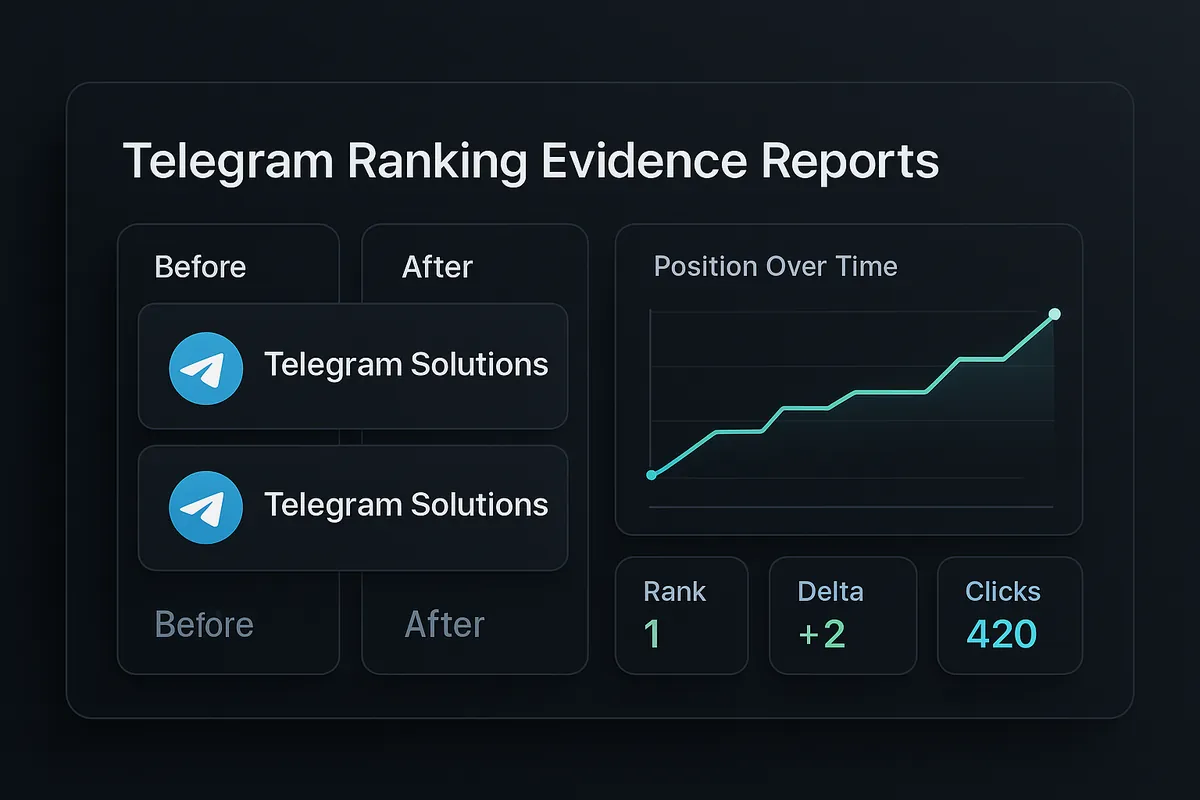
Every campaign reports the one number that matters: where your channel ranks for the target keyword, captured as dated search screenshots on a fixed cadence. Not estimated reach, not a vanity dashboard — the actual position a real user sees, tracked from the campaign's first week to its last. That evidence is also how the guarantee works. We scope each campaign against a specific keyword and a target position, and if the keyword hasn't moved into the agreed range inside the scoped window, the campaign keeps working it at no additional charge until it does. Ranking isn't instant and the index recalculates on its own schedule — roughly every one to four weeks — so the guarantee is built around evidence over a window, not a same-day promise no honest provider can make. This Telegram channel ranking service sits alongside the rest of the YourSolutions services, each built on the same earn-it engineering.
Ranking compounds with everything else you run on Telegram. A channel that ranks top-three for its keyword pulls a steady trickle of search joins on its own — and pairing that with a Telegram mass DM service to seed the first wave of real, engaged members makes the climb faster, because the seed members are exactly the engagement quality the ranker is looking for. The two systems feed each other.
Ready to own your keyword?
Sources
- Telegram — Top Peer Rating. Telegram's official API documentation describing how peers are scored with exponential time-decay and sorted for surfaces such as the global search tab.
- Telegram — Usernames and Secret Chats 2.0. Telegram's announcement of public usernames and how they make channels and accounts discoverable in global search.