A Telegram member adder tool scrapes targeted usernames from one group and adds them into yours automatically. The risk isn't the idea — it's execution: Telegram's 2026 anti-spam system flags reckless add velocity and fresh accounts. YourSolutions builds a member adder tool engineered around that reality — aged sender accounts, trust-band-aware pacing, and real-account filtering. The tutorial below shows it running.
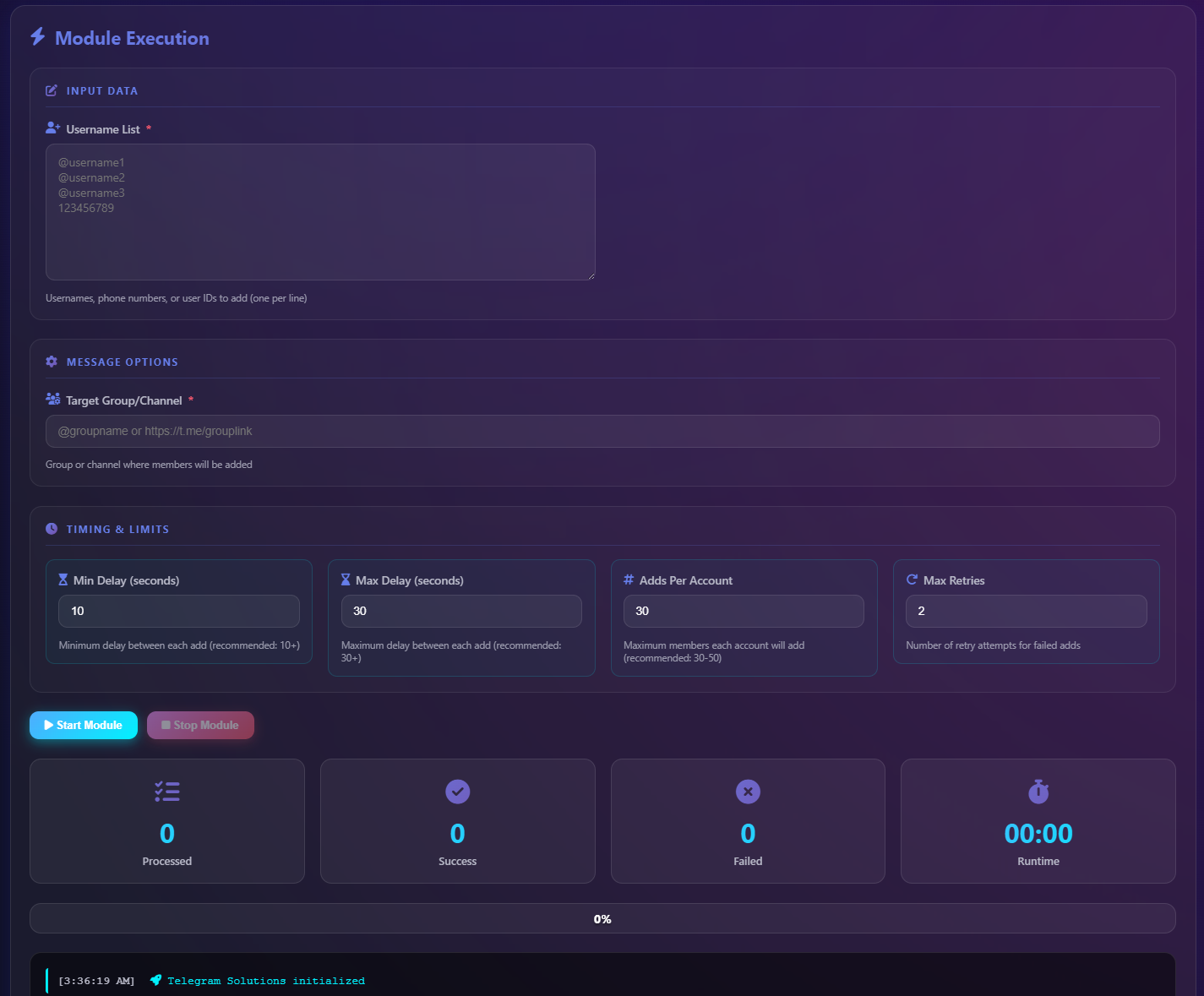
Here's a number most member adder tool pages skip. As of 2026, the daily ceiling for adding members to a Telegram group isn't a fixed cap — it's a dynamic band, somewhere between 0 and roughly 45 accounts per day, set by your account's trust score. Zero is the floor. A brand-new account can sometimes add nobody at all before Telegram throttles it.
We build member adder software for exactly that constraint, and we've put it to work across something like 90 Telegram growth campaigns through 2025. The lesson that shaped the product: a tool to add members to Telegram isn't risky because the idea is bad — it's risky when it ignores how Telegram scores accounts. So this page does two things. It explains how member adder tools actually work and where the ban risk comes from, and it shows you the YourSolutions tool that's engineered around it. The tutorial video is right below.
What is a Telegram member adder tool, exactly?
A Telegram member adder tool is software that automates two steps a person could technically do by hand: scraping a list of usernames out of an existing group, then adding those usernames into a group you control. The category is wider than most people expect. It covers open-source Python scripts built on the Telethon or Pyrogram libraries, paid desktop applications, browser extensions that piggyback on your logged-in web session, and fully managed setups where a provider runs the whole operation for you. They all share one core loop: collect identifiers, authenticate as one or more accounts, and issue add requests on a timer. What separates a member adder tool from simply buying members is control — you supply the accounts, the targets, and the risk tolerance. That control is the entire selling point. It is also the part a tool either supports with real safety engineering or leaves entirely on you.
One distinction worth fixing early: a member adder tool is not the same as a bot you add to your group. A management bot lives inside your group and does moderation or welcome messages. A member adder tool runs from the outside, on accounts you control, and its entire job is to move people in. Different category, different risk profile.
How a member adder tool actually adds members
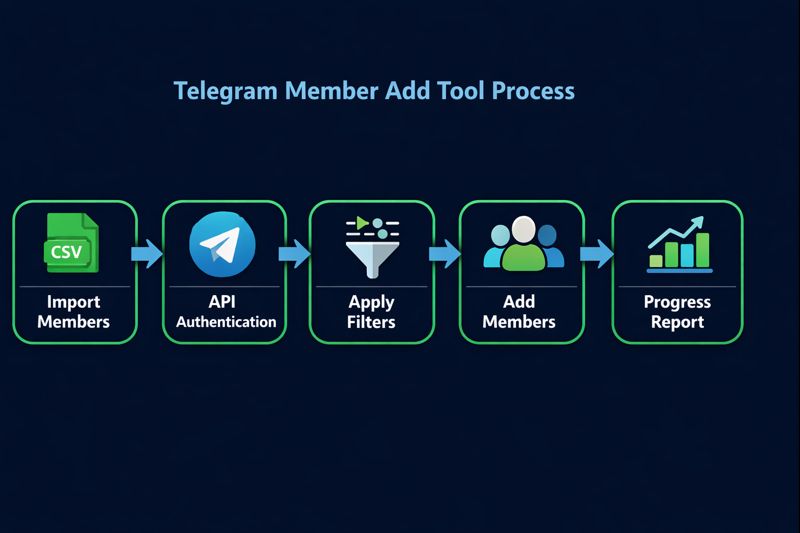
Under the hood, every member adder tool runs the same four-stage sequence. First it authenticates: you connect one or more Telegram accounts, usually through the official API with an api_id and api_hash, or through a saved session string. Second it scrapes, pulling the visible member list from a source group and exporting usernames and user IDs, often straight to a CSV file. Third it filters — the better tools drop accounts that are obviously inactive, privacy-restricted, or already in too many groups, while the cheap ones skip this entirely. Fourth it adds, issuing invite requests on a delay you set, typically anywhere from 5 to 90 seconds apart. The pipeline is mechanically simple. The hard part was never the code. It is that stages one and four are exactly the behaviors Telegram's anti-spam system was built to catch, and no amount of clever scripting changes what the platform sees from its side.
In practice, stage three is where the cheap tools fall down. A script that skips filtering will happily import accounts that left Telegram months ago, accounts with privacy settings that block the add outright, and accounts already maxed out on group membership. You pay for those failed attempts in account trust score, not in dollars.
The four kinds of tool — and what each one really costs
Not every member adder tool carries the same price tag or the same exposure, and the sticker cost is usually the least interesting number on the page. An open-source script is "free" only if you don't count the Telegram accounts it burns through — and it will burn through them. A browser extension is cheap and runs on a single logged-in session, which makes it the fastest thing to set up and the easiest thing for Telegram to fingerprint. Desktop adder software sits in the middle, with multi-account support and configurable delays, but the account warming is entirely on you. A managed setup shifts the operational work, and the account risk, onto the provider, charged at a per-member rate. The table below is the version we would hand a client asking which to use — with the real-cost column filled in honestly, rather than the way a vendor's landing page fills it.
| Tool type | How it works | Real cost | Ban exposure |
|---|---|---|---|
| Open-source script (Telethon / Pyrogram) | You supply accounts and API keys; the script scrapes and adds | "Free" — but it burns through your accounts fast | Highest: no rate intelligence, no warming logic |
| Browser extension | Runs inside your logged-in Telegram Web session | $20 – $80 / month | High: single account, trivial to fingerprint |
| Desktop adder software | Multi-account, configurable delays, CSV import | $50 – $300 one-time or subscription | Medium-high: depends entirely on account warming |
| Managed setup / done-for-you | Provider supplies the accounts and runs the adds | $0.01 – $0.05 per member | Shifts to the provider — quality depends on how it's built |
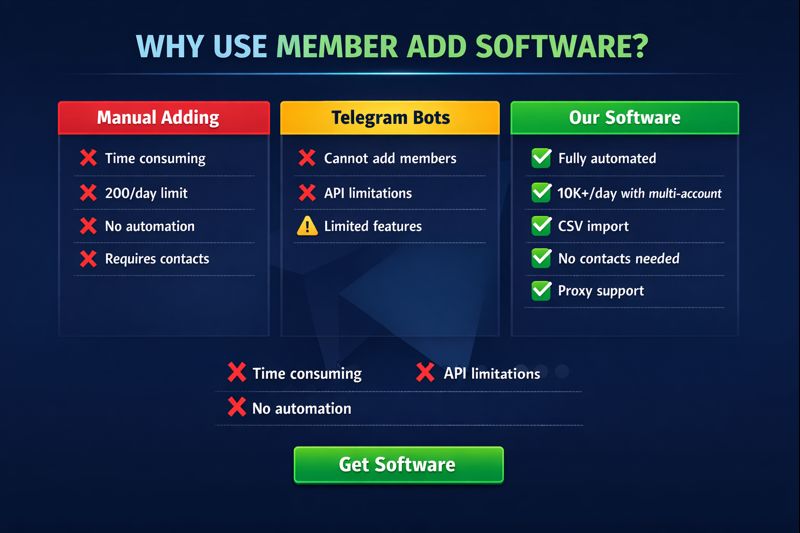
No row in that table is automatically "safe" — each is only as good as its account handling. That is the gap the YourSolutions member adder tool was built to close: it sits in the desktop-software category, but ships with a warmed sender pool, trust-band-aware pacing, and real-account filtering already wired in.
Will a Telegram member adder tool get your account banned?
The short answer: the tool doesn't get you banned — the behavior does, and the tool just makes that behavior easy to do at a scale Telegram notices. Telegram's Terms of Service explicitly prohibit adding users to groups and channels they did not ask to join, and the Spam FAQ spells out what follows: reported accounts get limited, temporarily at first, then permanently. We have worked through more than 60 account-recovery tickets where an adder tool was involved, and the pattern barely changes. A fresh account starts adding on day one, crosses an invisible velocity threshold within hours, and gets restricted before it has added 50 people. That account was not flagged for using "bad software." It was flagged because it did something a real person almost never does — add dozens of strangers to a group in a single afternoon. The brand on the software matters less than how it handles that footprint, which is what a tool should be engineered to manage.
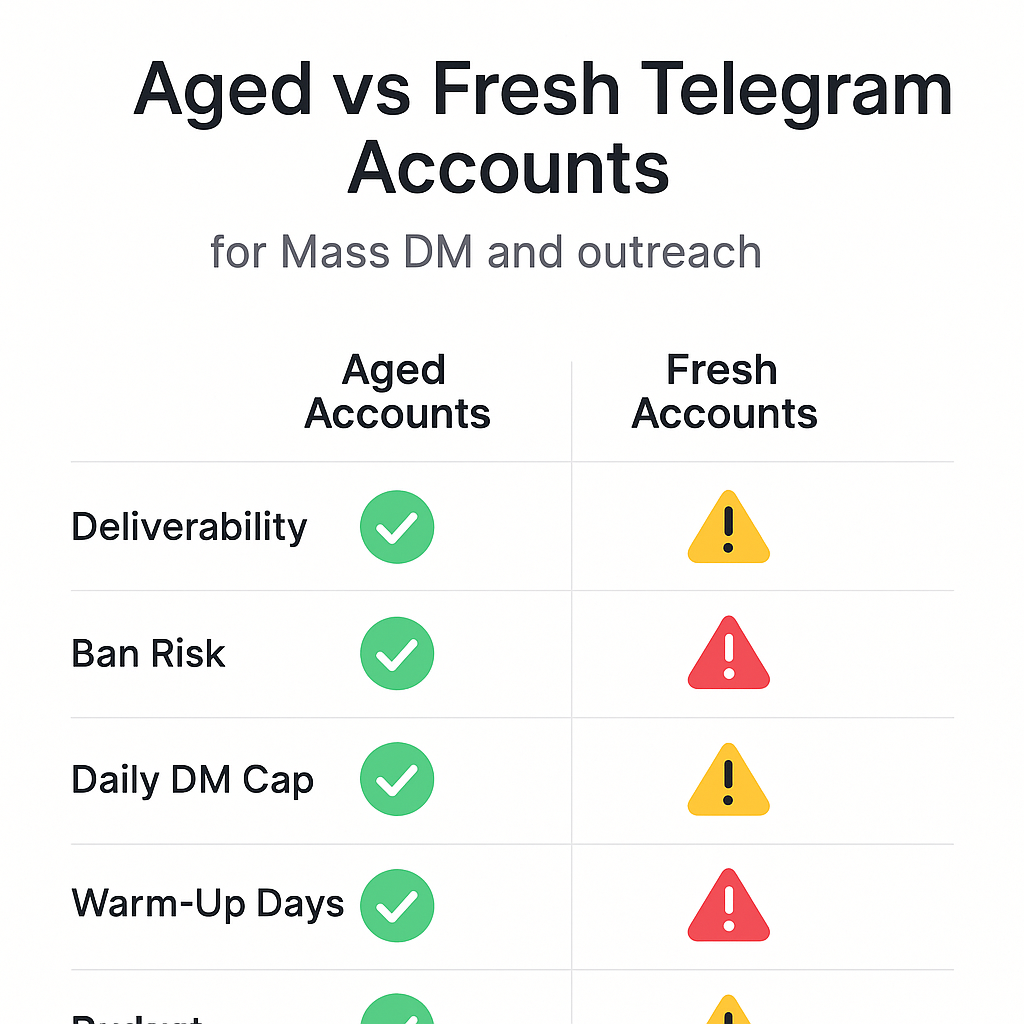
The accounts most likely to survive are the ones that look least like a tool is driving them: aged, with real message history, joining and reading groups before they ever add anyone, and adding slowly. That profile is expensive to build — which is why the YourSolutions tool runs on a pool we have already warmed, instead of handing you fresh accounts and a delay slider.
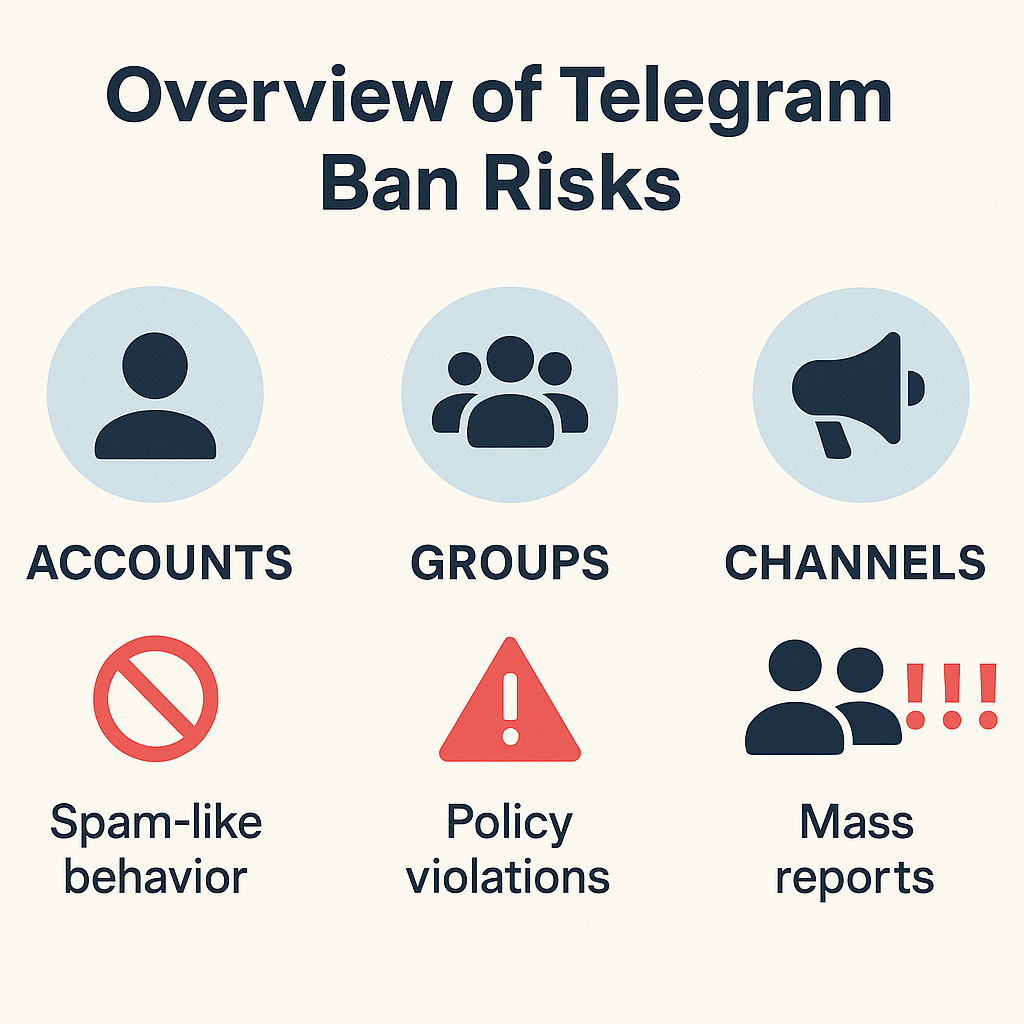
Across those sixty-plus recovery tickets, four factors decided who got restricted and who skated through:
| Factor | Lower risk | Higher risk |
|---|---|---|
| Account age | Aged accounts with real message history | Fresh accounts adding on day one |
| Add velocity | Stays inside Telegram's dynamic 0–45/day trust band | 100+ adds per day per account |
| Target relevance | Members pulled from your actual niche | Random scraped lists from any group |
| Account behavior mix | Posts, joins, and reads — then occasionally adds | An account that does nothing but add |
The YourSolutions member adder tool is configured for the left column of that table by default — aged accounts, paced velocity, niche targeting. If you want it set up for your channel, the contact page is the direct route.
Why most added members are fake — and disappear within days
The members a tool adds and the members that stay are two different numbers, and the gap between them is brutal. When a tool scrapes a source group, it cannot see which accounts are real, active people and which are bots, dormant accounts, or recycled numbers — it just grabs the list. So a meaningful share of every imported batch is dead weight the moment it lands. Then Telegram runs its own housekeeping: the platform removes accounts it identifies as fake on a rolling basis, and a channel that gained 8,000 "members" on Monday can watch a third of them vanish by Friday with no notification at all. We have tracked imports where the 30-day retention rate sat under 40 percent. The count spikes, the screenshot looks great, and then the line slides back down — except now the engagement ratio is wrecked, because the accounts that left were never going to open a post anyway.
This is the part a member adder tool has to get right, and most don't. The YourSolutions tool filters every scraped list against activity and account-age signals before a single add request goes out, so the batch that lands is closer to the batch that stays. The full math on why retention drives your search position is in our breakdown of Telegram member quality.
Are there limits on how many members you can add?
Yes, and they are stricter than most tool marketing admits. A Telegram group lets you add members manually only until it reaches 200 — past that point the Add Member option closes for anyone who is not already a contact, and the group converts to a supergroup. Channels behave the same way for direct adds. Beyond that 200-member wall, no tool can genuinely "add" anyone; the best it can do is distribute invite links or send invitations, both of which people can simply decline. On top of the structural cap sits the dynamic daily limit. As of 2026, the number of members a single account can add in a 24-hour window is not fixed — it floats roughly between 0 and 45, governed by that account's trust score, and a new account may add nobody at all. So when a panel advertises "10,000 members added," either a large fleet of accounts is each doing a small throttled share, or the numbers are not what they look like.
Those structural limits are documented in Telegram's own FAQ, and they don't bend for marketing copy — which is why the YourSolutions tool paces each account inside its trust band automatically. A panel advertising "50,000 members, 48-hour delivery" is either a large account fleet at a throttled crawl, or a number that was never really added.
How the YourSolutions member adder tool is built
Everything above is the reason the YourSolutions member adder tool is built the way it is. It runs on a pool of aged sender accounts with real message history, not fresh accounts that flag on day one. It paces every add inside Telegram's dynamic trust band instead of racing to a number, so velocity never crosses the line that triggers a restriction. Before anyone is added, scraped lists are filtered against activity and account-age signals, which keeps the imported batch real rather than padded with dormant profiles. Targeting is niche-first: members are pulled from communities adjacent to yours, so the people who land are people who might actually stay. Multi-account distribution spreads the work so no single account carries a suspicious load. And every run is logged, so you can see exactly what was added and what held. Same add mechanic every tool uses — built so the footprint stays clean.
The member adder tool is one piece of the YourSolutions stack. It pairs with our Telegram mass DM service for direct outreach into those same niche audiences, and with our Telegram channel ranking work, which turns a growing base of real members into durable search visibility. For how member quality feeds the 2026 ranker, the Telegram search ranking guide covers every signal.
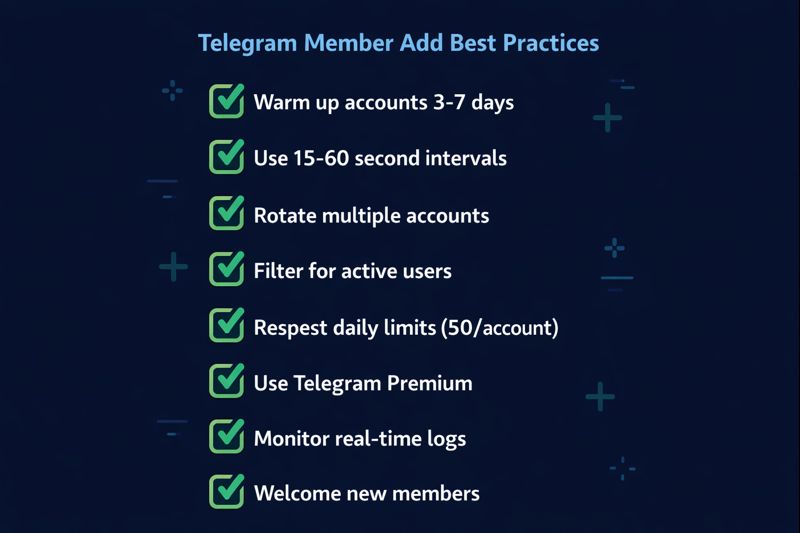
Run it the way the tutorial above shows, and the count grows clean — accounts intact, members real enough to actually open your posts.
Sources
- Telegram Terms of Service — prohibits adding users to groups and channels they did not ask to join.
- Telegram Spam FAQ — describes how reported accounts are limited, first temporarily and then permanently.
- Telegram FAQ — documents the 200-member manual-add limit and the conversion of groups to supergroups.
Frequently asked questions
Is a Telegram member adder tool free?
Some are. Open-source member adder scripts built on Telethon or Pyrogram cost nothing to download — but they run on Telegram accounts you supply, and aggressive adding burns through those accounts quickly. Paid desktop tools run roughly $50 to $300, browser extensions $20 to $80 a month, and managed panels charge per member, usually $0.01 to $0.05. The cash price is rarely the real cost.
Will I get banned for using a Telegram member adder tool?
The behavior is what gets flagged, not the tool itself — but the tool decides how that behavior looks. Fresh accounts adding fast get restricted within hours. The YourSolutions member adder tool runs aged accounts and paces every add inside Telegram's trust band, which keeps the footprint low-risk. No tool removes the risk entirely, but engineering changes the odds substantially.
Are the members added by a member adder tool real?
It depends entirely on filtering. A tool that scrapes and adds blindly will import bots, dormant accounts, and recycled numbers — and Telegram removes those on a rolling basis, so the count drops within a week. The YourSolutions tool filters scraped lists against activity and account-age signals first, so the members it adds are the members that stay.
How many members can I add to a Telegram group per day?
There's no fixed number. As of 2026, Telegram applies a dynamic daily limit tied to each account's trust score — roughly 0 to 45 members in 24 hours, with new accounts at the bottom of that band. The YourSolutions tool paces each account automatically inside its band and spreads the load across multiple accounts. Note too that groups only allow manual adds until 200 members, then convert to supergroups.
What's the difference between a member adder tool and buying members?
A member adder tool gives you control over targeting and pacing; buying members hands you a finished number with no say in who is in it. With the YourSolutions tool you get the control of a tool plus a warmed account pool and real-account filtering — so you are not trading control for safety, or accepting a count of accounts that don't engage and don't last.
Can a member adder tool add members to a channel or only groups?
Both groups and channels allow direct adds only up to 200 members. Past that wall, no tool can genuinely add anyone — it can only distribute invite links or send invitations, which the recipient can decline or ignore. Tools that advertise unlimited channel adding are really doing throttled invite distribution across many accounts, not true adding.
Is there a safe way to add members to Telegram?
Safety comes from how the tool is built, not from avoiding tools. A member adder tool running aged accounts, trust-band-aware pacing, and real-account filtering — the way the YourSolutions tool is configured — keeps the footprint clean. The reckless version, fresh accounts racing to a number, is what gets restricted. The tutorial video above shows the safe setup in practice.