Talk through a Telegram mass DM campaign
Telegram mass DM is bulk one-to-one outreach: a message sent directly into the private inboxes of thousands of targeted users, not broadcast to a channel. A managed Telegram mass DM service handles the parts that get accounts banned — warming sender accounts, isolating each behind its own proxy, varying the message text, and pacing sends under Telegram's limits. YourSolutions runs the campaign end to end and reports delivery per account.
Most Telegram mass DM campaigns don't fail at the send. They fail three days earlier, when someone buys fifty fresh accounts, points them at a scraped list, and watches every one of them hit a spam-lock by the second batch (sometimes the first). The message was fine. The targeting was fine. The accounts were never going to survive.
That gap — between sending a message and sending it from infrastructure that lasts — is the whole job. This page covers how a managed Telegram mass DM campaign actually runs at YourSolutions: how senders are warmed, how targets are found, where Telegram's limits really sit, and what it costs.
What is Telegram mass DM?
Telegram mass DM is one-to-one outreach run at scale: the same targeted message delivered into thousands of individual private inboxes, one account at a time. It is not a channel broadcast. A broadcast only reaches people who already subscribed; a mass DM reaches people who haven't heard of you yet, and it lands as a native push notification on their phone instead of sitting in a feed they may never open. That push-notification visibility is the entire reason the channel works. The trade-off is that Telegram treats unsolicited messages to non-contacts as the single most spam-sensitive action on the platform. So a real Telegram mass DM service is not a "send" button — it is the infrastructure that makes the send survivable: aged sender accounts, isolated proxies, varied message text, and a sending pace slow enough that the platform reads it as a person, not a script.
How a YourSolutions campaign runs, week by week
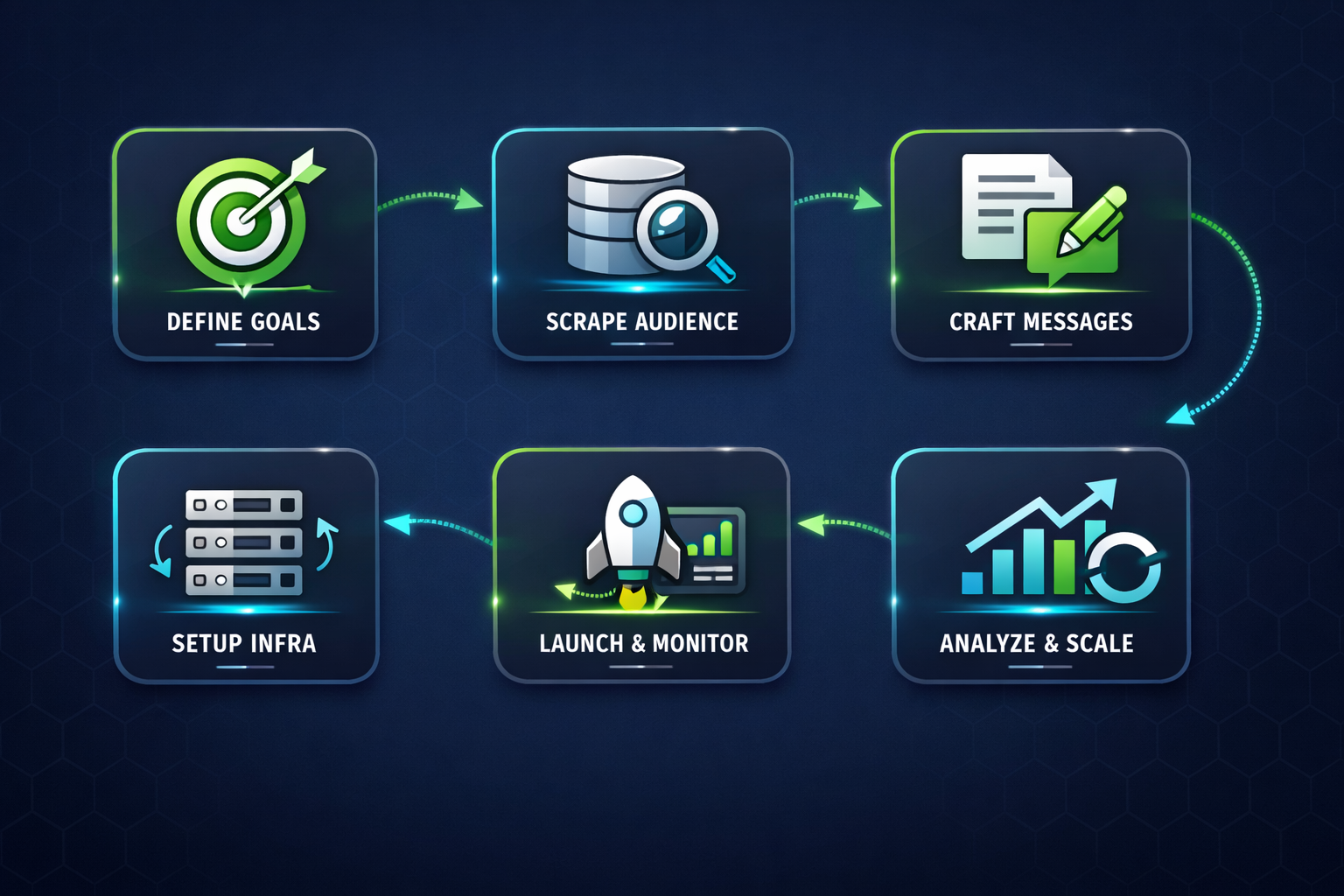
A managed campaign moves through four stages, and the first two matter more than the send itself. Stage one is sourcing: we scrape the groups and channels where your audience already gathers, then filter that raw list down — bots out, deleted accounts out, long-inactive accounts out. Stage two is preparation: sender accounts are pulled from a warmed pool, each one already aged and carrying real activity history, and the message is run through variation so no two recipients get a byte-identical text. Stage three is the send itself, paced with randomized delays and per-account daily caps. Stage four is reporting: delivered, read, and replied counts come back per account, so you can see which segments of the list actually moved. Most campaigns clear the first send window inside 24 to 48 hours of onboarding.
- Day 0–1 — Onboarding and list scrape. We confirm the offer, the audience, and the volume, then scrape the source groups and channels.
- Day 1–2 — Filtering and prep. The raw list is cleaned, sender accounts are assigned from the pool, and message variations go through review.
- Day 2 onward — Paced sending. Messages go out across the account pool with randomized delays and per-account daily caps respected.
- Throughout — Live reporting and replacement. Delivery is tracked per account; any sender that degrades is swapped without stopping the run.
How we target the right people
Targeting is where most mass DM Telegram campaigns quietly lose their ROI. A scraped list of 50,000 usernames is not an audience — it is 50,000 strangers, and a meaningful share are bots, deleted accounts, or people who will never open a DM from an unknown sender. We build the list the other direction. Start from the groups and channels that match your niche, scrape the active participants, then filter on signals that predict a real human: recent activity, account age, profile completeness, and whether the account actually posts. For B2B offers we can match the filtered list against your ideal-customer profile before a single message goes out. The principle is the same one behind member quality over raw count — a smaller list of real, active, relevant people out-converts a giant list of noise every time, and it keeps the sender accounts healthier while doing it.
Telegram's real limits — and the "50 a day" myth
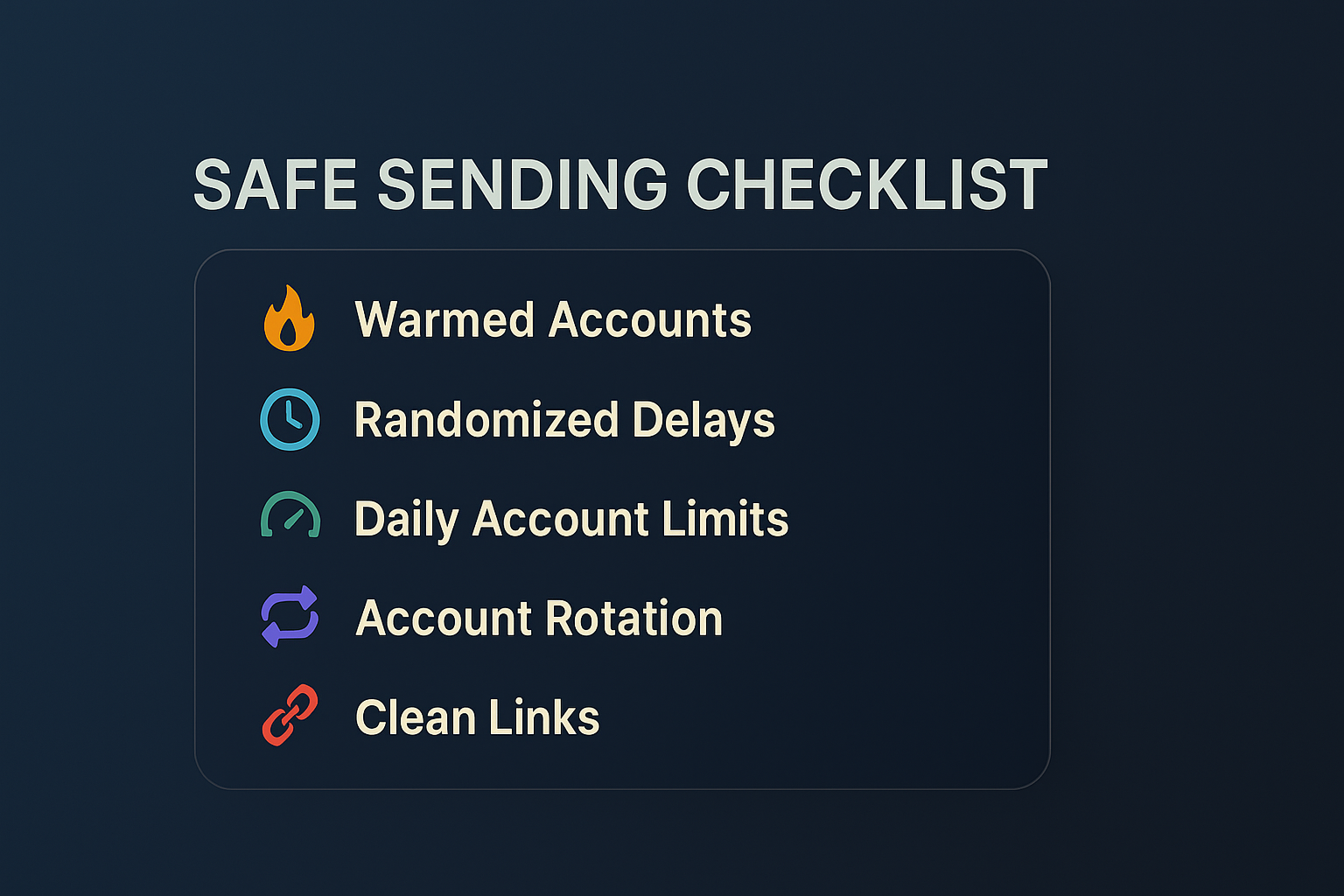
Search for Telegram mass DM limits and you will see one number everywhere: 50 messages per account per day. It is repeated so often it sounds official. It is not. Telegram does not publish a clean per-day cap for direct messages. What it actually enforces, according to Telegram's own spam FAQ, is a behavioral system: if recipients report your account, or its pattern looks automated, it gets limited — and a limited account can no longer message non-contacts at all. The real constraint is account state, not a magic number. A fresh account can be spam-locked after two or three unsolicited messages. An aged, warmed, proxy-isolated account has real headroom. This is why the per-account daily figure is a range, not a constant, and why the only durable way to scale volume is more healthy accounts — not more messages per account.
| Account state | Can message non-contacts? | Practical daily range | Main risk |
|---|---|---|---|
| Fresh (under ~2 weeks) | Heavily restricted, often blocked | 0–20, if any | Instant spam-lock on a few unsolicited sends |
| Warming (2–4 weeks, light activity) | Limited | 20–40 | Throttle if the pace spikes |
| Aged + warmed (1 month+, real history) | Yes, within reason | 80–150 | Report-driven limits if targeting is sloppy |
| Aged + warmed + proxy-isolated pool | Yes | Scales with pool size | List quality, more than platform limits |
The table above is operational, not official — the numbers come from what we see across our own sending pool, cross-referenced against the community-tracked Telegram limits reference. Telegram deliberately keeps the exact thresholds fuzzy, because a published number is a number that gets gamed. The practical takeaway: a Telegram mass DM sender account is only as useful as its warm-up history, and the moment you treat accounts as disposable, your cost per delivered message goes up, not down.
DIY Telegram mass DM bot vs. a managed service: which is worth it?
The phrase mass dm telegram usually turns up two kinds of results: open-source scripts and gig listings. The DIY route is real — you can wire up a Telegram mass DM bot with the Telethon library, buy your own accounts, rent proxies, and run it yourself. People do. The question is not whether it works; it is what it actually costs once you count the parts nobody advertises. You are now in the business of sourcing accounts, warming them, managing session files, rotating proxies, and re-warming whatever dies. A "free" script sits on top of a stack that is not free and not fast. A managed service collapses that stack into onboarding: the warmed pool already exists, the proxies are already isolated, and an account that degrades mid-campaign is swapped without stopping the run. The comparison below is the honest version.
| Factor | DIY bot / script | Managed service |
|---|---|---|
| Setup time | Days to weeks — API keys, Telethon, proxies, sessions | Hours — onboarding only |
| Account supply | You buy and warm your own | Warmed pool included |
| When an account dies | Your loss, your re-warm | Replaced, campaign continues |
| Targeting | Raw scrape, you filter | Scraped and filtered for you |
| Reporting | Console logs | Per-account delivery dashboard |
| Real cost | "Free" tool + accounts + proxies + your time | Scoped per campaign, quoted upfront |
What does a Telegram mass DM campaign cost?
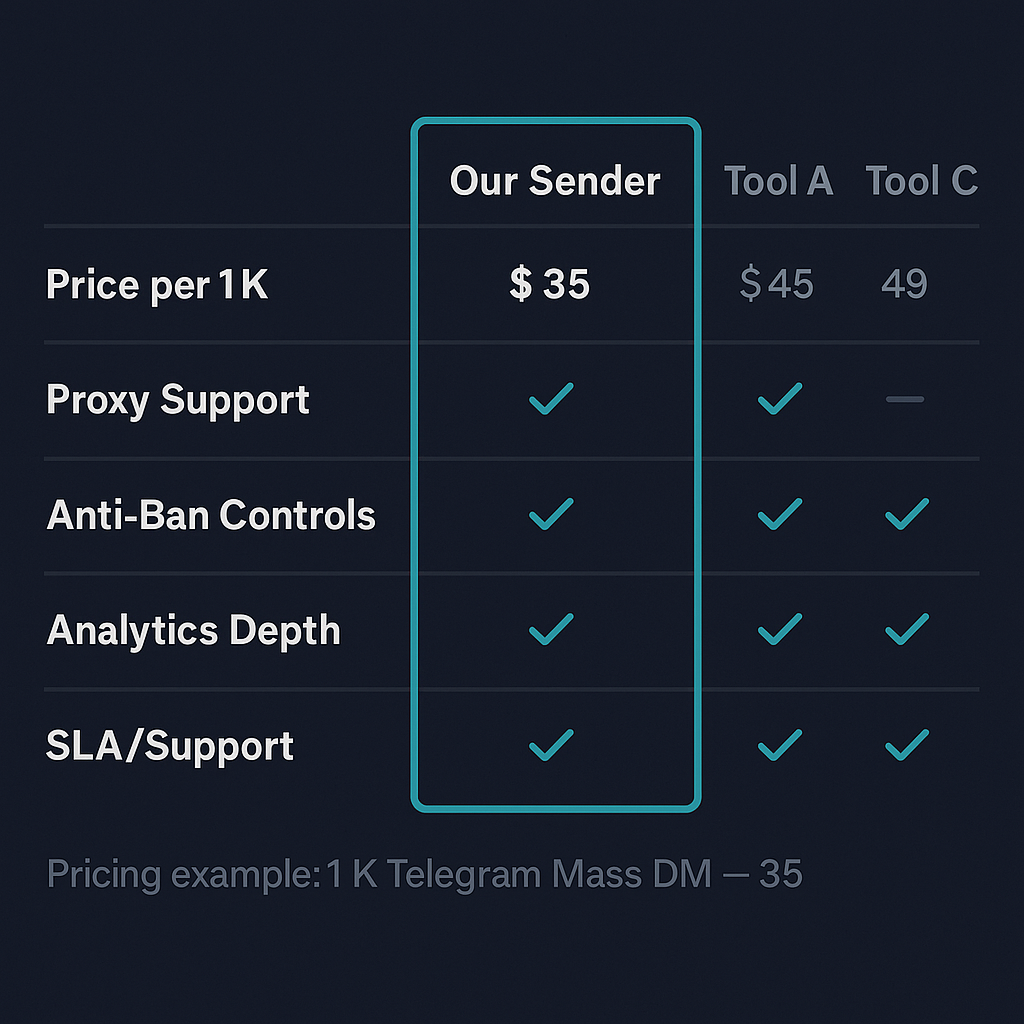
Pricing in this space has a visible market rate: based on our Q2 2026 review of freelance marketplaces and Telegram-native sellers, raw bulk-send gigs tend to land somewhere around 30 to 50 US dollars per 1,000 delivered messages. We will not pretend a managed campaign is the same product as a raw blast, because it is not — and the price reflects that. A YourSolutions campaign is scoped before it starts, against three variables: how many messages, how complex the targeting is, and how much account warm-up the volume demands. You get the number before the campaign runs, not after. There are no per-message surprises and no charge for senders that need replacing mid-run. If the campaign is small and the list is clean, it is priced like that; if it needs a large warmed pool and tight ICP matching, it is priced like that instead. The fastest way to a real number is to tell the team what you're trying to reach.
What you get back: tracking and the delivery guarantee
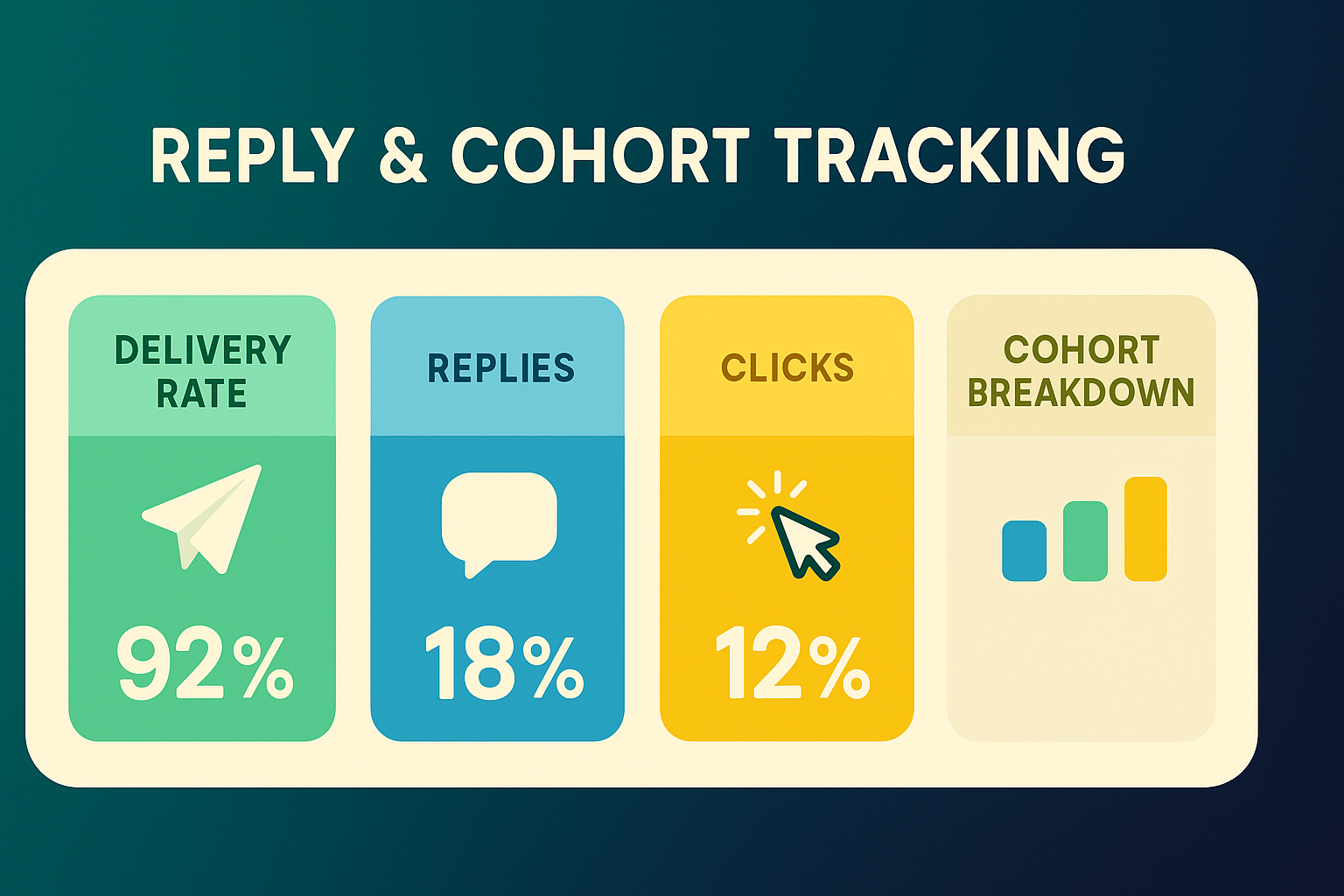
Every campaign reports back at the account level, not as a single vanity total. You see messages delivered, messages read, and replies received, broken down per sender account and per list segment — which is the data that tells you whether the targeting worked, not just whether the send completed. That reporting is also how the guarantee is enforced. If a sender account degrades or is limited partway through a campaign, it is replaced from the pool and the run continues — you are not charged for the dead account and the campaign does not stall waiting on it. The delivery commitment is concrete: the message volume you scoped is the volume that goes out, across healthy accounts, at a human pace. This Telegram mass DM service sits alongside the rest of the YourSolutions services lineup, each one built on the same account-survival engineering rather than burn-and-replace.
Outreach also compounds with everything else you run on the platform. A DM campaign that points people at a channel which actually ranks in Telegram's in-app search keeps paying after the send window closes — the two systems feed each other.
Ready to scope your campaign?
Sources
- Telegram — Spam FAQ. Telegram's official explanation of how accounts get limited for unsolicited messaging and how to appeal a restriction.
- Telegram Info — Telegram Limits. Community-tracked reference for Telegram's account and rate limits.