A Telegram bulk message sender is software that pushes the same message into many private Telegram inboxes — either through Telegram's Bot API (capped at 30 messages per second), a userbot tool driving real Telegram accounts, or a managed service running a warmed sender pool behind proxies. Each path trades scale, deliverability, and account safety differently, and only the last reliably scales past a few hundred cold sends without burning accounts.
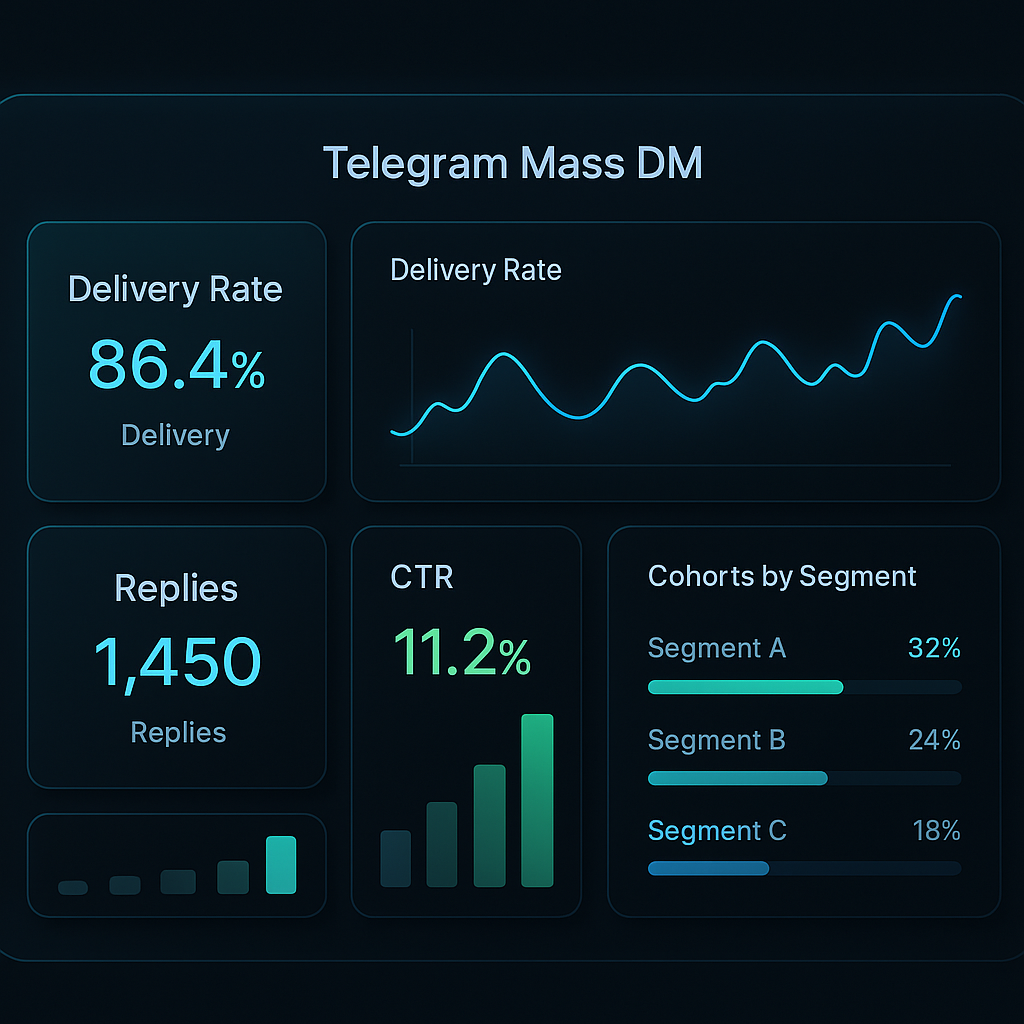
Most people typing "telegram bulk message sender" into Google are not really looking for software. They are looking for a list of people who will see their message. The software is just the conveyor belt. And almost every conveyor belt sold under that label does one of three very different things — which is why the SERP feels like ten tools that all promise the same outcome and almost none of them deliver it the same way.
We ship and run a managed sender pool for clients (it sits behind the same infrastructure as our Telegram mass DM service), so this guide is written from the operator's side of the table. I'll spell out the three real categories, where each one breaks, the actual rate limits, what the popular tools do, and which path makes sense for your campaign size. No "revolutionary" language. Just the math.
Need a managed Telegram bulk sender, not another tool?
What is a Telegram bulk message sender?
A Telegram bulk message sender is, at the simplest level, a piece of software that takes a list of recipients and pushes the same (or lightly varied) message into many private chats at once. That is the only thing the label reliably means. Underneath it sit at least four very different mechanisms, and they are not interchangeable: an official Bot API broadcaster, a userbot tool that drives logged-in Telegram accounts, a bulk messaging service that includes Telegram as one channel among several (SMS, WhatsApp, Telegram bundled), and a managed sender pool with proxies, warmed accounts, and human-paced delivery. The vocabulary is loose — people say telegram bulk message, telegram bulk messaging, bulk message telegram, bulk messaging telegram, send bulk telegram messages, or telegram send bulk message, and they all point at the same general task. What changes is which mechanism actually does the work, and that single choice determines whether your campaign clears the first send window or whether the senders are spam-locked by Tuesday afternoon.
The three ways to bulk message on Telegram, ranked by what they actually do
Strip the marketing off every tool on the SERP and you get three operating modes. Each one solves a different version of "send a lot of messages," and the difference matters more than the tool brand on the website. Picking the wrong mode is the most common — and most expensive — mistake we see new clients make before they come to us.
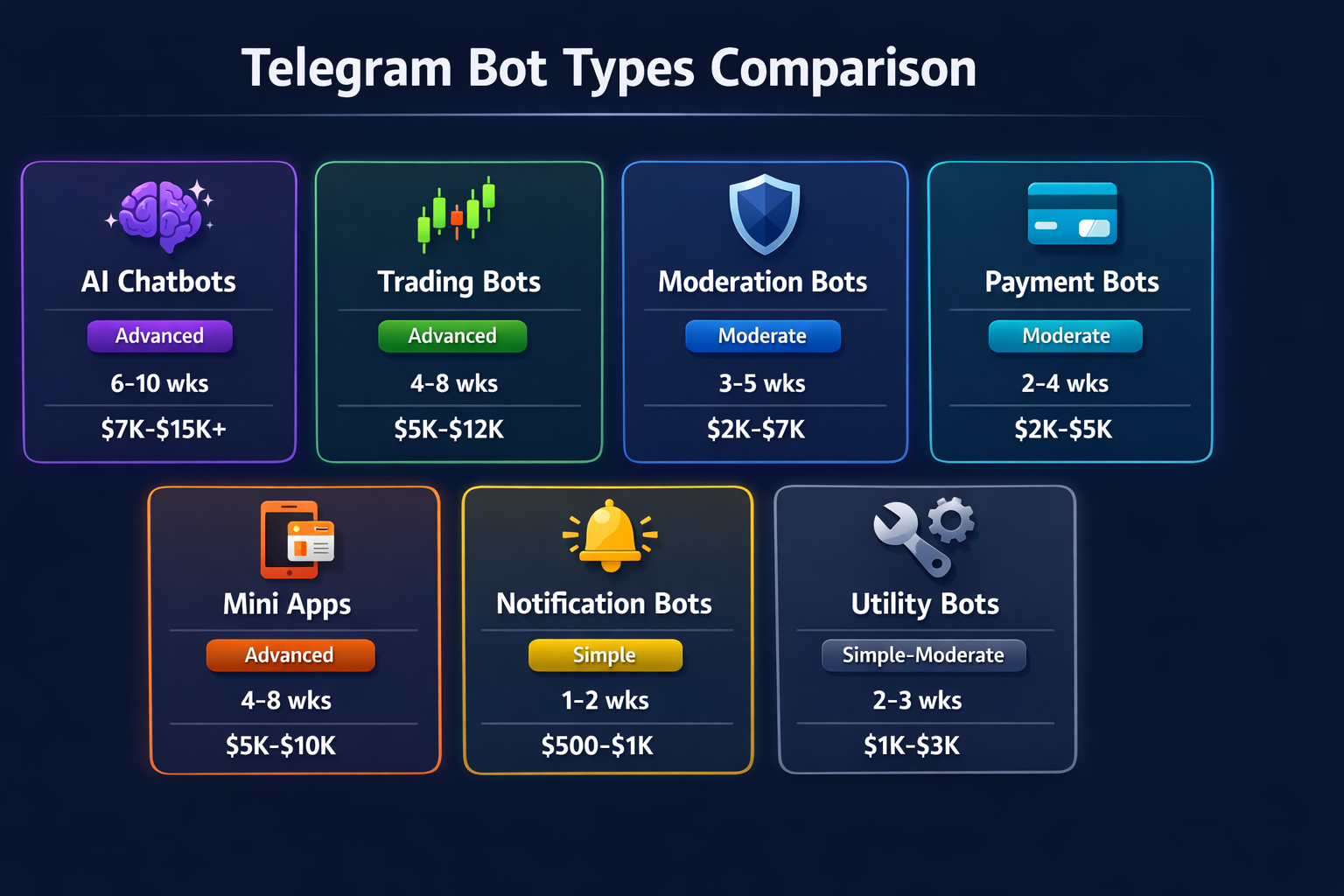
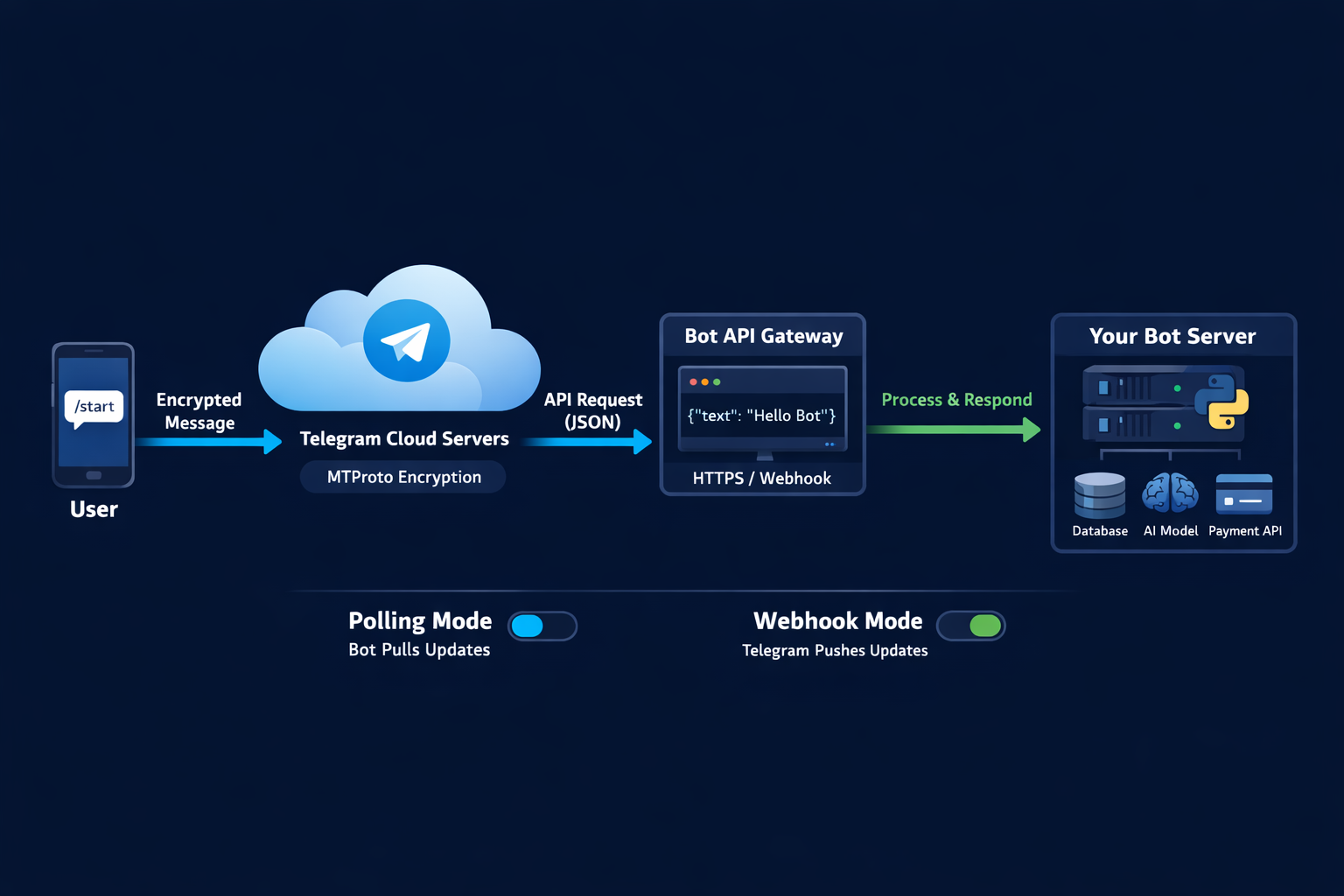
Mode 1 — Bot API broadcast. A telegram bot bulk message setup runs on the official Telegram Bot API. It can only message users who have already started a chat with the bot (the /start handshake), which means it is excellent for newsletter-style sends to a subscriber base and useless for cold outreach. It is also the safest mode by a wide margin: nobody's personal account is at risk, because the bot itself is the sender, and bot bans are rare absent egregious abuse. The rate ceiling is the famous 30 messages per second across different chats.
Mode 2 — Userbot tool. A telegram bulk message bot of the userbot type doesn't use the Bot API at all. It logs into one or more regular Telegram accounts (through libraries like Telethon or Pyrogram on the MTProto protocol) and sends from them as if a human were typing. This is the only path that can DM strangers from a scraped list. It is also the path where 90% of the ban risk lives, because every cold send is the platform's most spam-sensitive action. Tools in this category include TeleSender, TexSender, Teleplus, TGBotSender, and various Chrome extensions. They put the sending capability in your hands — and the account-burn risk too.
Mode 3 — Managed sender pool. A managed service operates the userbot model on infrastructure you don't have to build: a warmed pool of aged accounts, each on its own residential or mobile proxy, with scraping, filtering, message variation, pacing, and live replacement when an account degrades. We run this internally; so do a handful of agencies. It costs more per campaign than DIY tools and saves the cost of the accounts that would otherwise be burned learning what works. The differentiator is operational, not technical — the code is not the hard part. The hard part is the 200 small decisions about when to slow down, when to swap senders, and how to read Telegram's anti-spam signals before a wave of limits hits.
Telegram bulk message rate limits — the 30/sec rule, the 50-a-day myth
Every honest conversation about a telegram bulk message sender starts with the numbers Telegram actually enforces. The official Bot API publishes them; the user side is governed by anti-spam signals that nobody publishes, but operating teams know within tight bands. Here is what actually applies in May 2026, pulled from the Telegram Bots FAQ and Telegram Info's limits tracker.
| Channel | Limit | What happens at the ceiling |
|---|---|---|
| Bot API broadcast (different chats) | ~30 messages / second | HTTP 429 errors; back off and retry |
| Bot API broadcast, paid tier (Telegram Stars) | Up to 1,000 messages / second | 0.1 Stars billed per message above the free allowance |
| Bot API to the same chat | ~1 message / second | Short bursts allowed, sustained sending throttled |
| Bot inside a group | 20 messages / minute | Bot is rate-limited from that group |
| Fresh user account, cold DMs | ~30 sends / day before spam-lock | Limited; "Cannot message non-contacts" |
| Aged, warmed user account, cold DMs | 100–200 sends / day, paced | Survives if pacing and variation hold |
That last row is where the so-called "50 a day rule" lives, and it has been catastrophically misread for years. 50 is not a hardcoded number Telegram enforces — it is roughly the safe floor for a typical aged account on a stable proxy, with paced delivery and varied content. Push to 150 on a properly warmed account with the right targeting and it survives just fine. Send 50 from a fresh account on a shared IP and it is locked by the second batch. The number is downstream of account state, not the other way around. Pace matters more than volume: 30 to 45 second delays between sends, randomized so the cadence is not robotic, plus message variation so the platform isn't seeing the same byte sequence land in fifty inboxes inside a minute. We learned that the hard way watching a 1,200-send campaign in early 2025 die at message 47 because every variant was 4 words too similar.
How to send bulk messages on Telegram safely
If you are going to send bulk messages on Telegram — through your own tool or someone else's — the playbook that survives Telegram's anti-spam system has not really changed since 2023, only tightened. The Telegram Spam FAQ spells out what the platform flags; the rest is operational discipline. Five rules carry most of the weight.
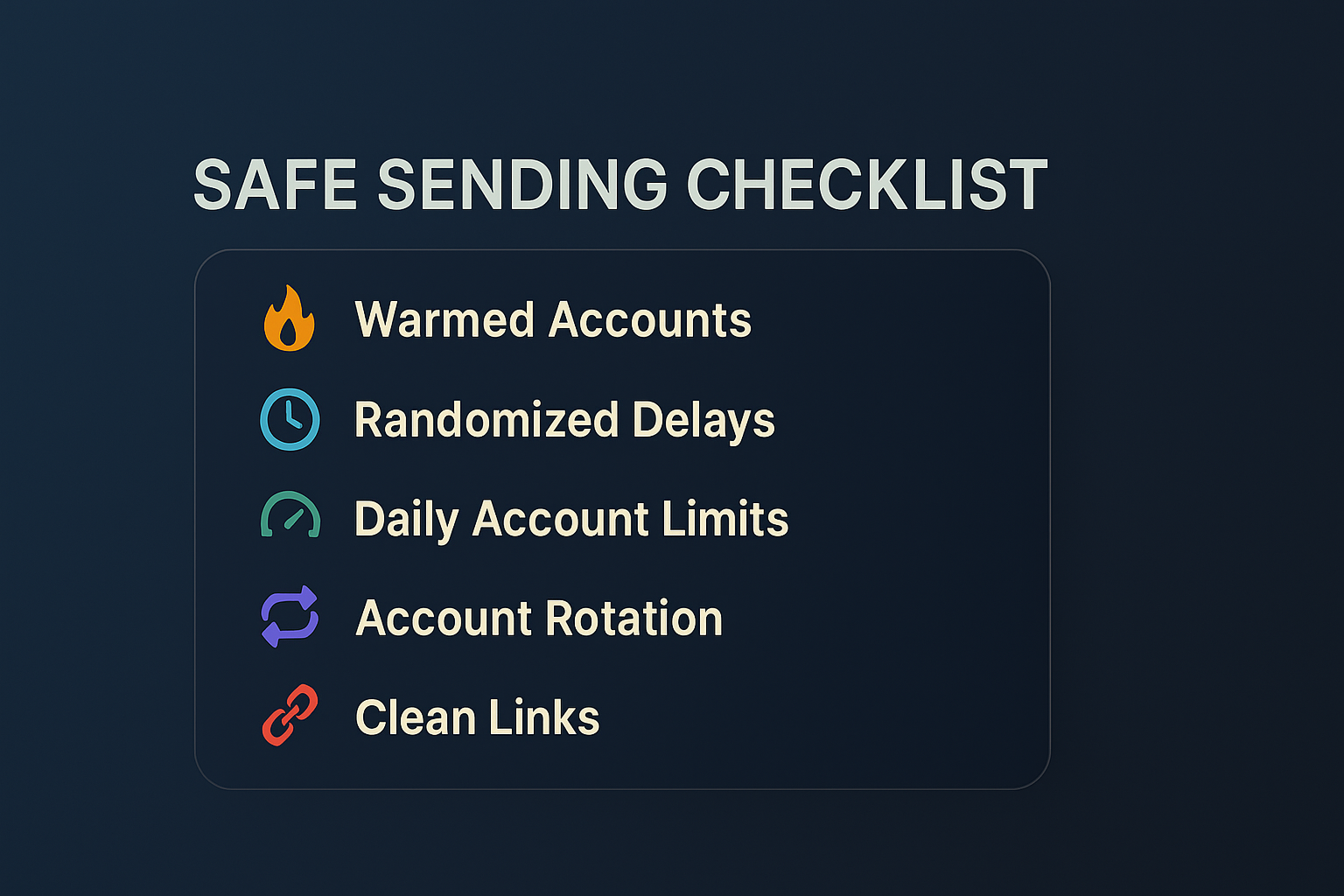
- Use aged accounts, never fresh ones. A new SIM-registered Telegram account on day one is the riskiest possible sender. Even four to six weeks of normal-looking activity — joining groups, reacting, light replying — changes the survival curve dramatically. This is why teams sourcing campaigns at scale buy aged Telegram accounts in bulk rather than spinning up fresh ones.
- One proxy per account. Same-IP clusters are the fastest way to get mass-banned. If account A is limited, account B on the same IP becomes high-risk inside an hour. Residential or mobile proxies, one per sender, are not optional past a few hundred sends.
- Vary the message text. Identical text into hundreds of inboxes in minutes is the textbook spam signature. Three to five variants, with the order randomized and small synonym swaps inside each, is the minimum.
- Pace at 30 to 45 seconds between sends, randomized. Per account. Not the aggregate. A sub-second delivery rate from a userbot is unmistakable.
- Filter the list before sending. Half the typical scraped list is bots, deleted accounts, or long-inactive users. Send to all of them and the bounce/no-response pattern itself becomes a spam signal. Filter first; the operational gains are immediate.
Notice what is missing from that list: any clever trick. There isn't one. The discipline is the trick. Tools that advertise "100% no-ban" anti-ban technology are selling pacing and proxies with a louder marketing layer. The infrastructure is the same; the survivability comes from how it is run.
Telegram bulk message sender software, compared
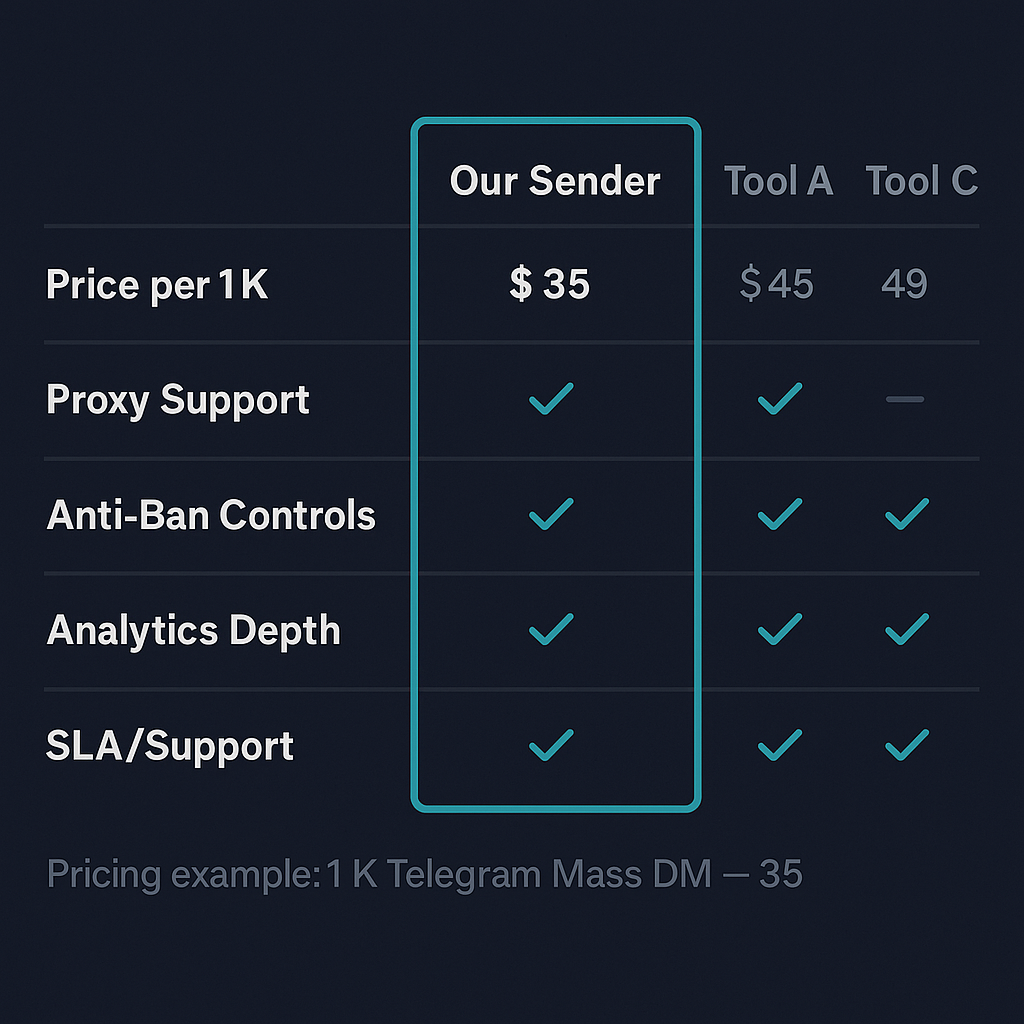
Eight of the top ten results for telegram bulk message sender software in mid-2026 are tool landing pages, each promising the same outcome with different feature lists. They are not identical, but the differences are smaller than the marketing implies. Here is how the most-cited names actually map.
| Tool | Mode | Free tier | Account model |
|---|---|---|---|
| TeleSender | Userbot (Chrome extension + cloud) | 30 messages/day, unlimited scraping | You supply accounts |
| TexSender | Userbot (desktop, Windows) | Trial only | You supply accounts |
| Teleplus | Userbot (cloud) | Limited free tier with delays | You supply accounts |
| TGBotSender | Userbot (desktop, Windows) | Trial only | You supply accounts; multi-account |
| Wadesk / TG Sender | Userbot (cloud, agency-scale) | Trial | You supply accounts, multi-account focused |
| Apify Telegram bulk message sender | Userbot (API) | Free Apify credits | You supply accounts |
| Bot API broadcasters (custom Python, etc.) | Bot API | Free, capped at 30/sec | Bot token, opted-in audience only |
| YourSolutions managed | Managed pool | None — scoped per campaign | We supply warmed accounts + proxies |
One pattern is worth calling out. Every userbot tool on that list does roughly the same thing — logs in as you, sends paced DMs, sometimes wraps scraping in — and every one of them puts the account-burn risk on the user. That is not a flaw; it's the model. The tradeoff for owning the workflow is owning the consequences when an account is limited. If you are running a single small campaign, that is fine. If you are running campaigns weekly with fresh creative each time, the accounting starts to favor a managed pool quickly.
DIY telegram bulk message bot vs a managed pool — when to pick which
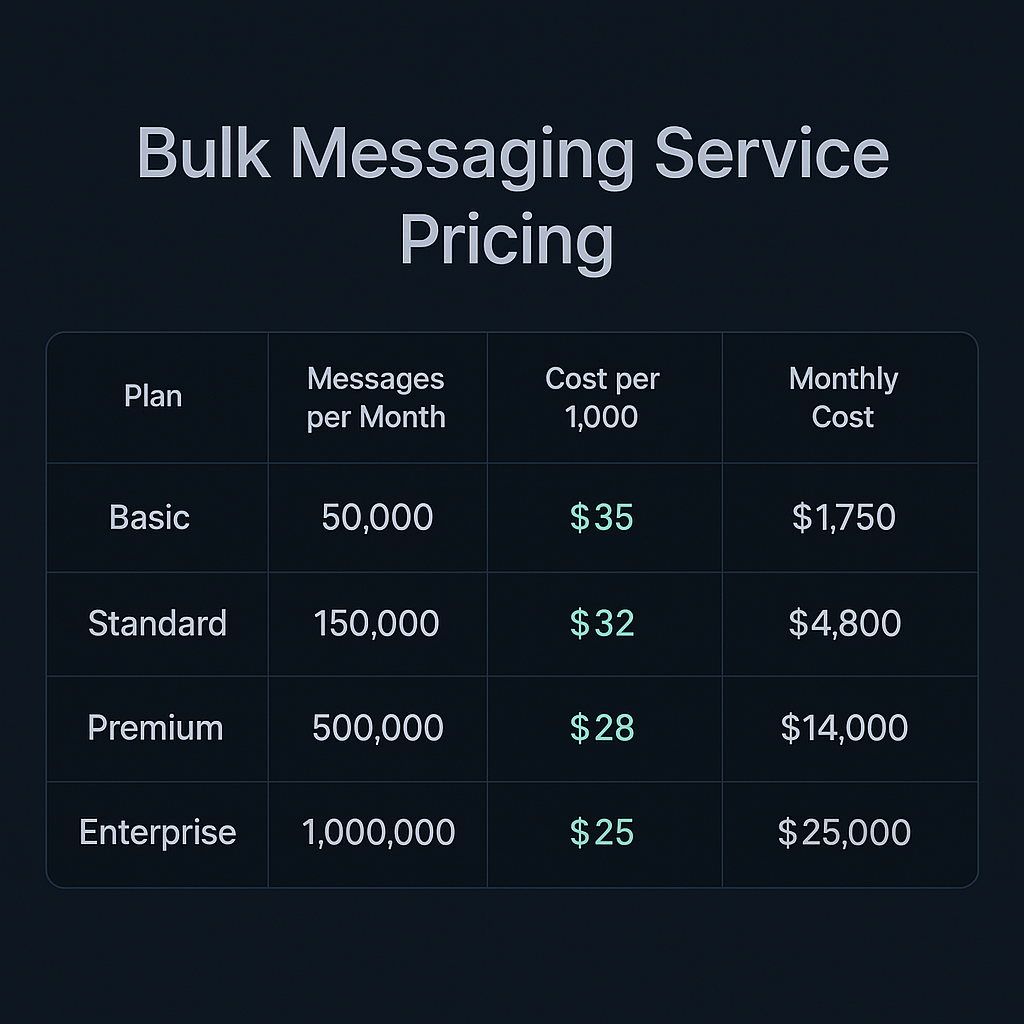
The DIY-versus-managed decision is mostly an economics question disguised as a feature comparison. The break-even sits somewhere around 3,000 to 5,000 cold sends per campaign, and the math is roughly this. A DIY tool license runs $20 to $80 a month. Aged Telegram accounts run $1.50 to $4 each. Decent residential proxies run $3 to $8 per account-month. So for a 5,000-send campaign you need roughly 40 to 50 warmed accounts (at a safe 100-150 sends each), $60 to $200 in account cost, $120 to $400 in proxies, plus the tool. Then you operate it. Then, on the first campaign, you absorb the learning curve — which usually means losing a meaningful share of those accounts to early misconfiguration.
A managed pool absorbs all of that on the operator side and bills per campaign. It is more expensive per-send for tiny runs (a 500-send campaign is silly to outsource), and dramatically cheaper at scale once you account for the accounts you no longer burn learning. There is a third axis too: time. A team that does this every day reads the early warning signals from Telegram — subtle delivery slowdowns, response-rate dips, soft-limit patterns — before they become bans. That instinct does not come from a tool; it comes from running thousands of campaigns. For a deeper teardown of how managed campaigns run, our Telegram mass DM page walks the four operational stages we use.
How to send bulk messages to Telegram group members
This is the question that drives most of the search traffic in this cluster, and the honest answer disappoints almost everyone the first time they hear it: you cannot just point a tool at a group and have it DM everyone in the member list. Telegram blocks that as a direct flow — a Bot API bot cannot start a chat with someone who hasn't messaged it first, and a userbot DMing every visible member at once will trip anti-spam inside the first dozen sends. The pattern that actually works is two staged steps, separated in time.
Step one is scraping the public group's roster — usernames, IDs, sometimes display names — and filtering it before anyone touches it. Bots, deleted accounts, and long-inactive profiles come out. Our own Telegram group scraper handles this stage, and the filtering matters more than the scraping. Step two is paced sending from a separate, warmed account pool, with the cleaned list as input, and the timing is what carries the load — 30 to 45 second delays per account, one proxy per account, message variation. A related path is to add the scraped members into your own group or channel rather than DMing them, which is what a Telegram member adder tool does, but adding strangers at volume carries its own anti-spam signature and is usually a noisier choice than well-targeted DMs.
How to delete Telegram messages in bulk (the opposite problem)
This page is mostly about sending, but the inverse question — how to delete telegram messages in bulk — lands here often enough to be worth a clean answer. Telegram does not ship a one-click delete-everything button, and it never has. The native pattern is selection-based: long-press a message on mobile (or click then Shift-click a range on desktop) to mark up to 100 at a time, then tap the trash icon. For a single chat, "Clear Chat" wipes the whole thread on your side — or "Delete for everyone" if you sent the messages in the last 48 hours. For wiping years of history across many chats, the only realistic path is a third-party tool: TgEraser (open source, Python, runs on a userbot session) is the most-cited option, and Redact.dev offers a paid GUI alternative. Both still work message by message — the speedup is automation, not bypassing Telegram's batching limit. Worth flagging that running an aggressive deletion script counts as automated behaviour, and the same anti-spam logic that watches sending is also watching mass deletion; pace it.
Should you buy a Telegram bulk message service?
"Buy telegram bulk message" as a search term is mostly people deciding whether to license a tool, hire an operator, or ignore the whole thing and use a different channel. The decision is cleaner if you separate three questions. First, is your audience opted in? If yes, the Bot API is the right answer and the cost is effectively zero. Second, do you need to reach cold lists at meaningful volume (3,000+ per campaign), recurring? If yes, a managed service usually wins on the math, especially once you price in the account churn from operating it yourself. Third, are you exploring? If yes, a DIY userbot tool with a free tier is the lowest-risk way to learn what the channel feels like before you scale; just budget for the accounts you will lose along the way.
A few specific use cases are worth naming. B2B outreach to startup founders works extremely well as paced, well-targeted Telegram DMs from a warmed pool — the channel converts because every message is a native push notification. Token launches and Web3 community spin-ups also lean on bulk sending, and the targeting bar is high because the audience is noisy. Adjacent verticals like OnlyFans Telegram promotion use the same infrastructure with different targeting and pacing. The other category that comes up is channel growth — if the underlying goal is more subscribers rather than more DMs, you may be better served by improving the channel's search ranking so it surfaces in Telegram's in-app search, which compounds without the per-send risk.
FAQ
What is a Telegram bulk message sender?
A Telegram bulk message sender is software that pushes one message into many private Telegram inboxes at once. It can run on top of the official Bot API, drive logged-in user accounts (a userbot), or be a fully managed sender pool. The categories share a name and almost nothing else — the Bot API can only message users who already started a chat with the bot, while userbot tools and managed pools can reach strangers, with very different ban risk.
How many bulk messages can a Telegram bot send per second?
Telegram's Bot API caps broadcast traffic at about 30 messages per second across different chats — push past that and you start getting 429 errors. In a single chat, a bot is limited to roughly one message per second, and inside groups it cannot send more than 20 messages per minute. A paid broadcast tier raises the global limit to 1,000 per second, billed in Telegram Stars beyond the free allowance.
Will my Telegram account get banned for bulk messaging?
It can. Telegram treats unsolicited messages to non-contacts as one of its most spam-sensitive actions, and a fresh account that sends fifty cold DMs in an hour will usually be limited the same day. The behaviour is what gets flagged — volume, velocity, identical text, and same-IP clusters. Aged accounts with proxies and 30 to 45 second delays survive far longer than fresh ones on the same IP.
How do you send bulk messages to Telegram group members?
You can't broadcast directly into the inboxes of strangers from a group's roster — Telegram blocks that path for bots. The working pattern is two steps: scrape the public group's member list (usernames and IDs), filter it down to real, active accounts, then have a warmed userbot pool send paced, varied DMs from that list. Sending inside the group is just a normal group message, and is capped at 20 per minute.
Is there a free Telegram bulk message sender?
Several. Most commercial tools have a free tier — typically 30 to 100 messages per day — and the Bot API itself is free up to its rate limit if your audience already opted in. Free is misleading, though. The tools run on Telegram accounts you supply, and the first batch of cold sends is where those accounts get spam-locked. Free in cash; expensive in burned accounts.
How do you delete Telegram messages in bulk?
Open the chat, long-press one message, then tap the rest you want gone — you can clear up to 100 at a time per batch. On desktop the same range-select works with Shift-click. For wiping your full history across many chats, third-party tools like TgEraser automate the loop, since Telegram itself does not ship a one-click delete-everything button. There is also Clear Chat for a single conversation.
Should you buy a Telegram bulk message service or run it yourself?
Run it yourself when the audience already opted in and the Bot API can do the job — that path is cheap and clean. Buy a managed service when you need to reach cold lists at scale, because the survivable infrastructure (aged accounts, proxy-per-account, scraping, message variation, replacement when an account degrades) is operationally heavier than most teams want to own. The break-even point sits somewhere around 3,000 to 5,000 sends per campaign.
Sources
- Telegram Bots FAQ — official broadcast and rate-limit documentation.
- Telegram Bot API — per-chat and per-group rate ceilings.
- Telegram Info — Limits — community-tracked user-account limits.
- Telegram Spam FAQ — what triggers spam flags and account limits.