Buying bulk Telegram accounts means purchasing pre-created PVA or aged accounts in batches — 10 at a time, or 10,000. The risk isn't the purchase. It's what happens next. Fresh PVA at $0.20 each dies within days of aggressive sending. Aged accounts at $3 to $15 each survive multi-week campaigns. We have watched both ends play out across more than 90 projects at YourSolutions. The format matters less than the operator.
Roughly 62% of the bulk Telegram accounts our team measured across 2025 client work failed within the first 14 days of campaign use. Not because the accounts were bad. Because the people running them treated 500 fresh PVA the way Telegram has trained its anti-spam system to flag. So this page does the math nobody on a vendor's landing page wants to do. What the four account formats actually cost once replacements are tallied, where the marketplaces sit, why bought accounts get restricted, when to use a bulk Telegram account creator instead, and the operational setup that decides whether your pool lasts.
If you've landed here because you have a campaign coming up and want the practical answer rather than a sales pitch, the rest of the article is structured for that. Skim the comparison table in the formats section. Read the survival math in the pricing section. The marketplace section names names. And the YourSolutions approach at the end is what we'd hand you if you asked us off the record what we actually do — because the operator's view is what most pages on this topic carefully avoid putting in writing.
What "bulk Telegram accounts" actually means
A bulk Telegram account purchase is the act of buying many pre-created Telegram accounts at once — typically anywhere from 10 up to a few thousand at a time — instead of registering each one by hand. The accounts themselves come in formats ranging from raw phone-verified logins to fully exported desktop sessions, and the buyer takes them over the moment a vendor hands over either the verification details or the session files. Bulk pricing scales down per unit as quantity goes up. A pack of 1,000 fresh PVA costs roughly half per account compared with a pack of 50. That economic gradient is precisely what makes the format attractive for any operation that needs many accounts working at once: outbound marketing campaigns, multi-account automation pipelines, controlled scraping pools, channel boosting, and so on. Volume buyers usually order in the 500-to-5,000 range, where vendors pre-build inventory.
One thing worth clarifying upfront. When most pages say "buy bulk Telegram accounts," they mean buying accounts that someone else made — not running a bulk Telegram account creator yourself. The two paths overlap but they are not the same operation, and the trade-offs differ. We'll cover both later. The buy path is faster and externalises the registration risk. The build path costs more in operator time but gives you control over every input, from the SMS provider to the proxy mix to the warm-up cadence.
The four formats — PVA, aged, session, TDATA — explained
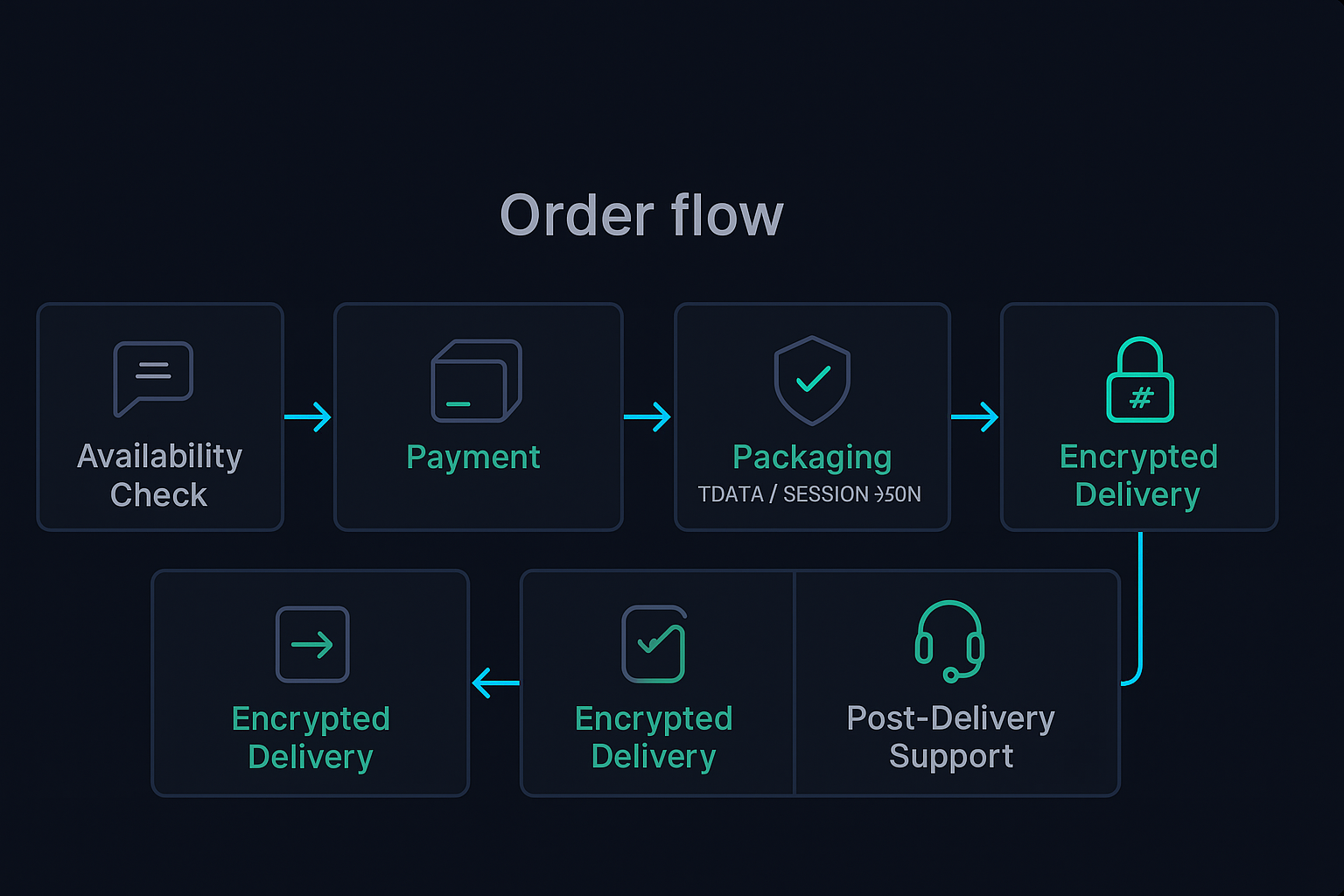
There are essentially four account formats on every reputable bulk marketplace in 2026. Fresh PVA, short for phone-verified accounts created within the last few weeks, are the cheapest and the lowest-trust. Aged PVA are accounts created months or years ago, sometimes left dormant and sometimes lightly warmed by the seller; their trust scores are substantially higher. Session-string accounts are delivered as small text files containing a Telethon or Pyrogram authentication token — they are API-native and ideal for scripts. TDATA accounts arrive as the full Telegram Desktop client data folder, including the entire local cache, so they look exactly like a real desktop user to the platform. The format decides what kind of automation you can plug the accounts into. It does not decide, on its own, how hard Telegram will look at the resulting traffic once the pool starts running.
The comparison below is the version we would hand a client choosing between formats before a campaign. Real cost (the second-from-right column) bakes in the replacement rate we observed across a six-month window. The "best for" column reflects how we actually deploy each format internally — not the way a vendor catalog markets it.
| Format | Avg price (each) | Best for | Detection vector |
|---|---|---|---|
| Fresh PVA | $0.20 – $1 | Throwaway, very short campaigns | New-account heuristics, OTP fingerprint |
| Aged PVA | $3 – $15 | Multi-week campaigns, member adding | Behavioural anomalies on dormant accounts |
| Session string | $0.30 – $2 | API automation (Telethon / Pyrogram) | Origin IP, single-device pattern |
| TDATA (Desktop) | $0.50 – $3 | Desktop emulation, native client behaviour | DC region mismatch, dormant cache replay |
Pricing reality — what aged vs fresh accounts really cost
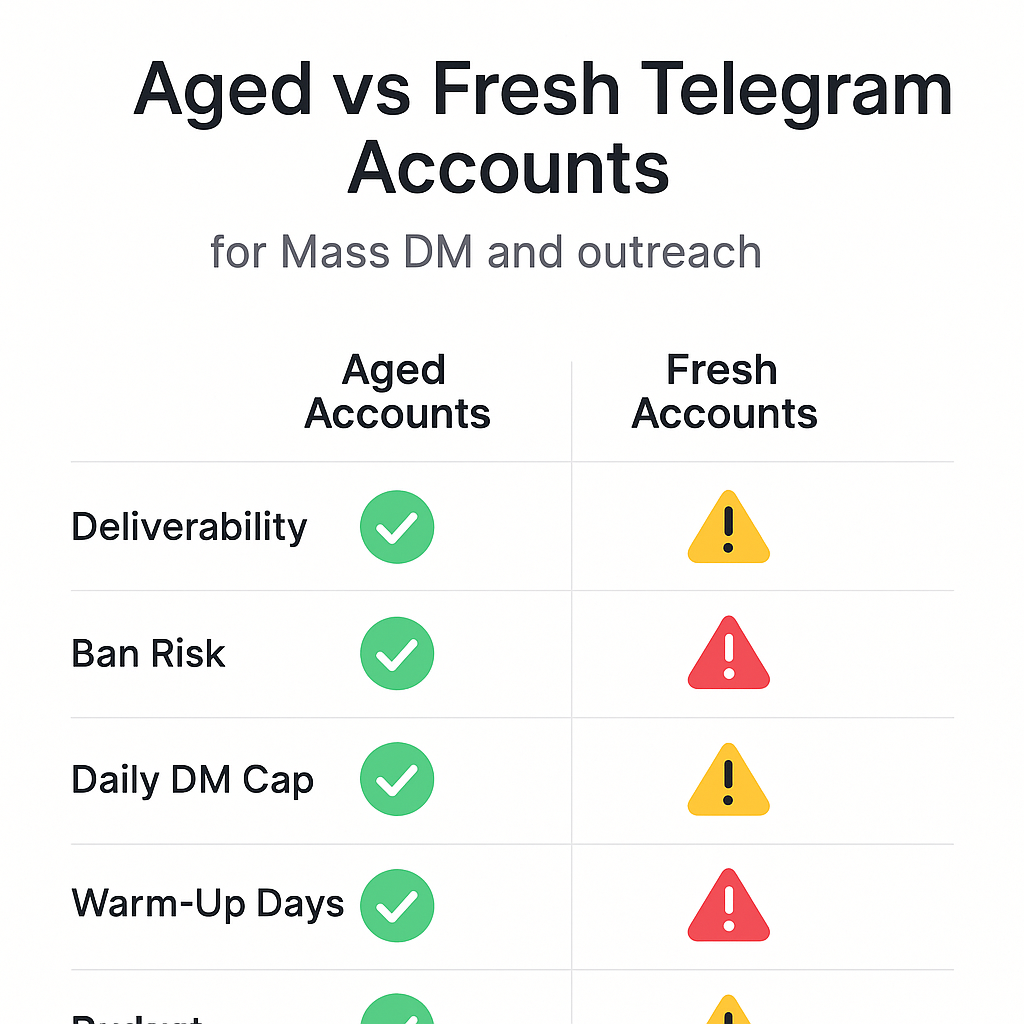
The sticker price on a bulk listing is the smallest number you should care about. Total cost is the unit price, plus the proxy, plus the warm-up time, plus the replacement rate once Telegram starts restricting the ones that don't survive. We have tracked this across roughly 90 campaigns through 2024 and 2025. Fresh PVA at $0.50 per account looks cheap until you factor in a 60% to 80% restriction rate over the first two weeks of sustained sending. The real per-surviving-account cost ends up two to five times higher than the listing. Aged accounts at $8 each look expensive until you compare them against the same arithmetic. Their survival rate sits closer to 75% to 85% over the same window, and the per-surviving cost lands roughly even with fresh once everything is tallied. Aged is rarely a luxury. It's a different distribution of where the money goes.
The numbers above are averages — your mileage will vary based on how aggressively you push the pool. We've seen aged accounts at 85% survival under a paced 5,000-message campaign drop to 40% the moment an operator doubled the daily send. Same accounts. Different operator behaviour. The cost curve is steeper than most landing pages admit.
Where bulk Telegram accounts are sold (and the marketplace risks)
The bulk Telegram account market has consolidated around a handful of public marketplaces and a much larger long tail of private resellers operating through forums and Telegram itself. AccsMarket, BuyAccs, Z2U, and a few specialist sellers carry the recognisable inventory. Each runs an open catalog with per-account pricing, country tagging, and either an automated delivery API or an escrow-style manual flow. The long tail is harder to assess. Forum-based sellers on BlackHatWorld and various Telegram brokers can offer lower prices and better aging, but verification is on you. Two recurring risks across both tiers are worth flagging. Account recycling, where a vendor sells the same account to multiple buyers and the first one to scale loses access. And warm-up theatre, where listings advertise aged-and-warmed accounts that are dormant ledgers, not behaviourally aged. The defensible filter is requesting a small sample batch before committing to a thousand-unit order.
One detail worth noting on the geography side. Country premiums are real, and they aren't always rational. US and UK accounts often carry a 50% to 100% markup over equally-aged Indonesian or Brazilian accounts, even though Telegram's anti-spam system does not weigh the origin country directly. The premium reflects buyer demand for matching-geo accounts in DM campaigns targeted at Western audiences. If your campaign target is geographic, the premium is worth it. If your use case is scraping or general automation, paying the premium is mostly habit.
Why bought accounts get banned (it's almost never the account)
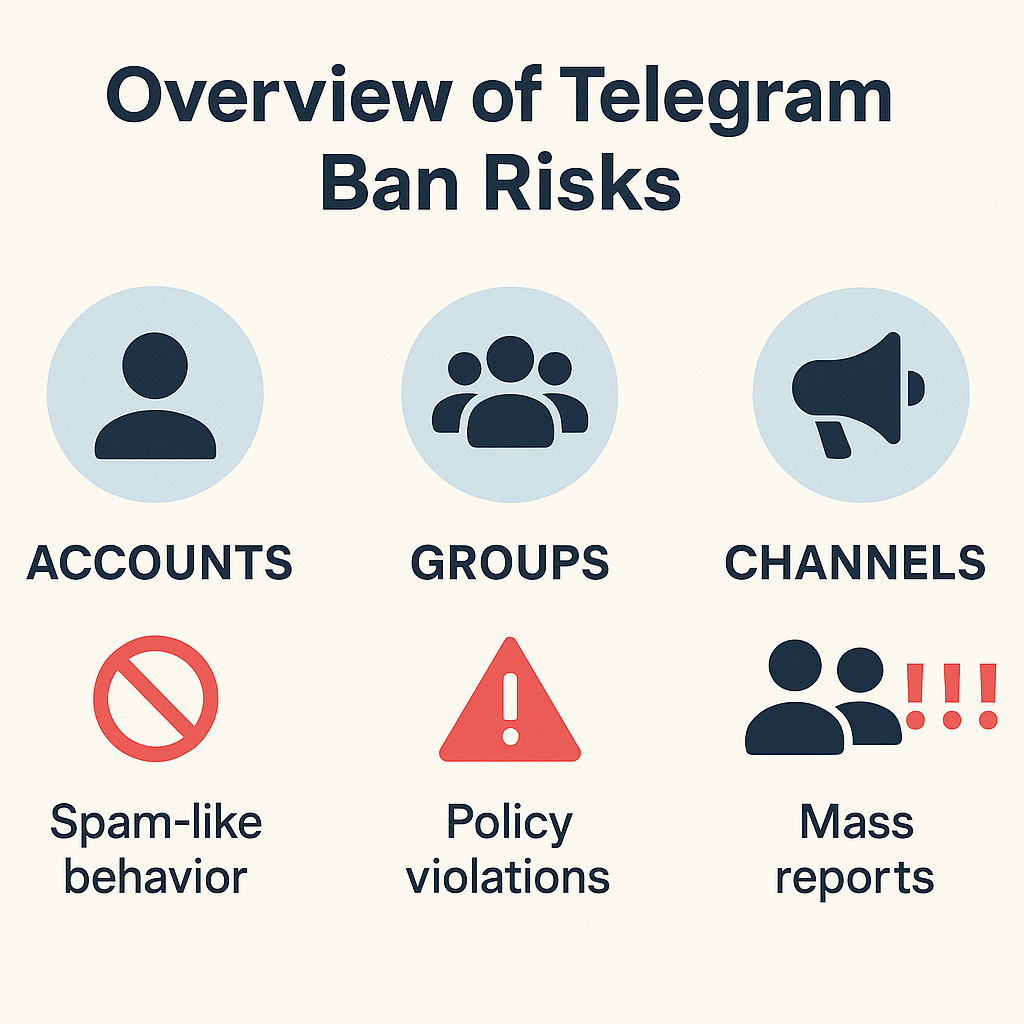
The ban pattern we see is consistent enough that it's basically the same story across formats. An operator buys 500 accounts, plugs them into a script with no proxy isolation, no warm-up, and a tight sending interval, and watches the restriction wave hit within 24 to 72 hours. The accounts themselves usually weren't the problem. Telegram's anti-spam system in 2026 scores behaviour, not provenance. It looks at sending velocity, message similarity across an account pool, IP-to-account binding consistency, action diversity, and account-age relative to action intensity. Aged accounts get more headroom on each of those dimensions, but the headroom is not infinite. We have seen aged-account pools incinerated in 36 hours by an operator who pointed 200 of them at a single Telegram mass DM campaign sharing one proxy. The account quality bought you a bigger envelope. The operator opened it too quickly.
Telegram's own Spam FAQ says the quiet part aloud: reported accounts get limited temporarily, then permanently. What the FAQ doesn't say is that the report threshold sits much lower for pools that look automated than it does for organic accounts. If your 500 accounts all send within a 90-second window from the same /24 subnet, the platform doesn't need user reports to find them. The behavioural fingerprint is the report.
Buying vs creating with a bulk Telegram account creator
A bulk Telegram account creator — the software flavour, names like Tele Diamond, ONE DASH, Telegram Expert, and the open-source Python emulator scripts — automates the registration side of the equation rather than the purchase side. You feed it SMS-verification API credits (5sim, sms-activate, or Smspva), a proxy pool, and the creator runs through registrations one after another, exporting each finished account as a session string or TDATA folder. The trade-off is mechanical. Buying skips the registration work but inherits a vendor's account hygiene. Creating gives you full control over inputs but transfers the SMS provider risk, the proxy churn, and the warm-up operation onto your shoulders. For operators running fewer than around 500 accounts, buying is usually faster end-to-end. Past that scale, running your own Telegram bulk account creator pipeline starts paying for itself, mostly because it removes the recycling and theatre risks described earlier — you know the provenance because you made it.
The break-even math is reasonably stable. SMS-API costs sit at roughly $0.05 to $0.15 per successful verification depending on country, proxies at maybe $1 to $3 a month per residential IP, and the operator-time cost is everything left. If you can build a creator pipeline that hits a 70% verification success rate (the realistic ceiling for emerging-market numbers), the per-account cost of a homegrown bulk Telegram account creator workflow lands at $0.30 to $0.80, well below the $3 to $15 aged-account price tag. The catch is that "create" only matches "buy aged" if you also run the warm-up — and most operators skip that step, which puts the created accounts in the same fresh-PVA failure mode they were trying to avoid.
The setup that keeps bulk accounts alive — proxies, warm-up, rotation
Account survival in 2026 is mostly about the layer Telegram sees, not the layer the operator buys. Three operational choices matter more than account format. First, proxy isolation: every account on its own residential or mobile IP, no shared exit nodes, and rotation only within a small geographic band the account was registered in. A Brazilian PVA suddenly logging in through a Frankfurt residential proxy is the cheapest trip to a restriction we know of. Second, warm-up cadence: even fresh PVA can climb to a usable trust score in 7 to 14 days if it's used like a real user — a few groups joined, sparse passive activity, no outbound DMs in the first 72 hours. Third, action rotation: spreading sending load across the pool so no single account exceeds Telegram's trust-band ceiling for a given day. Pools that follow these three rules survive multi-week campaigns. Pools that skip them survive a long weekend.
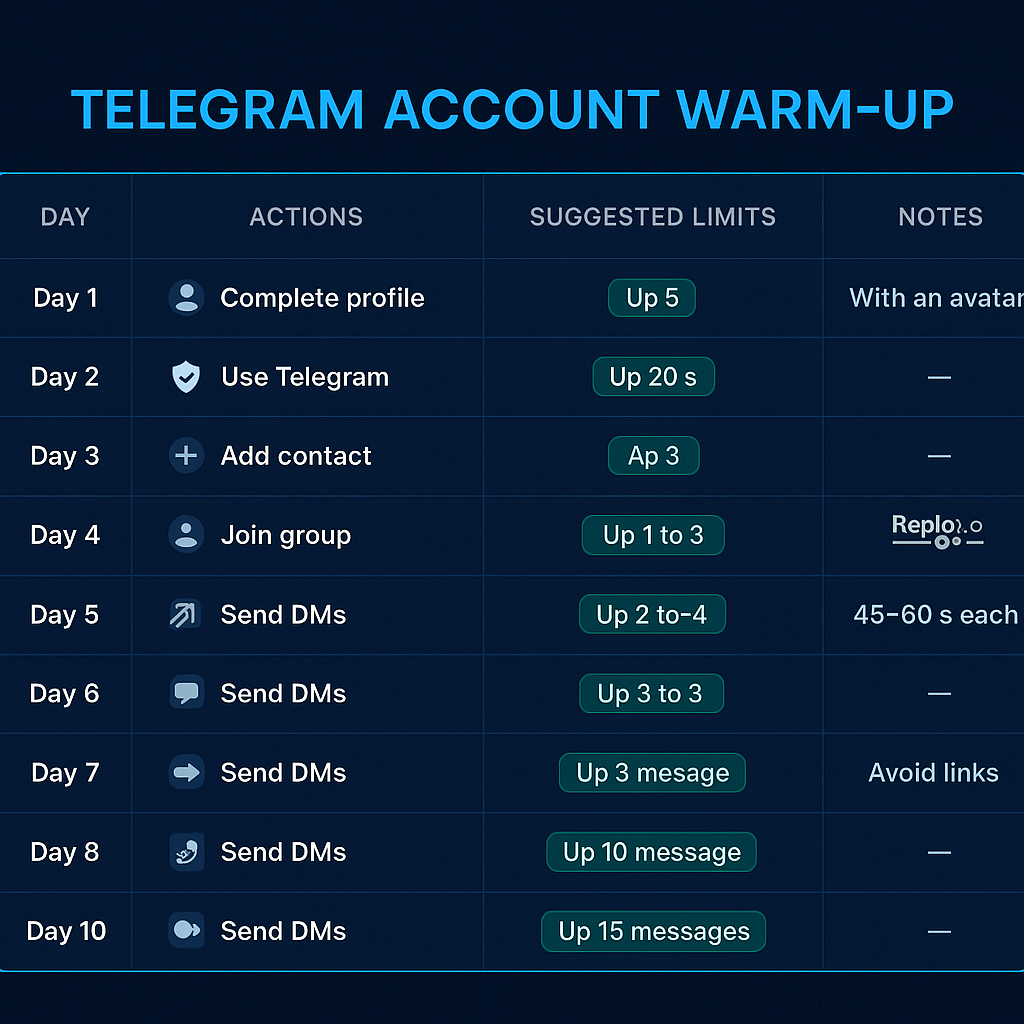
A concrete warm-up calendar we use on aged accounts before they enter a campaign: day 1 to day 3, login only, no actions; day 4 to day 7, join 3 to 5 public groups, read messages, no posting; day 8 to day 12, light passive engagement (reactions, channel joins); day 13 onwards, the account is cleared for the campaign workload it was bought for. The calendar costs five to twelve days. The replacement-rate savings make those days the cheapest part of the whole project.
How YourSolutions handles accounts inside campaigns
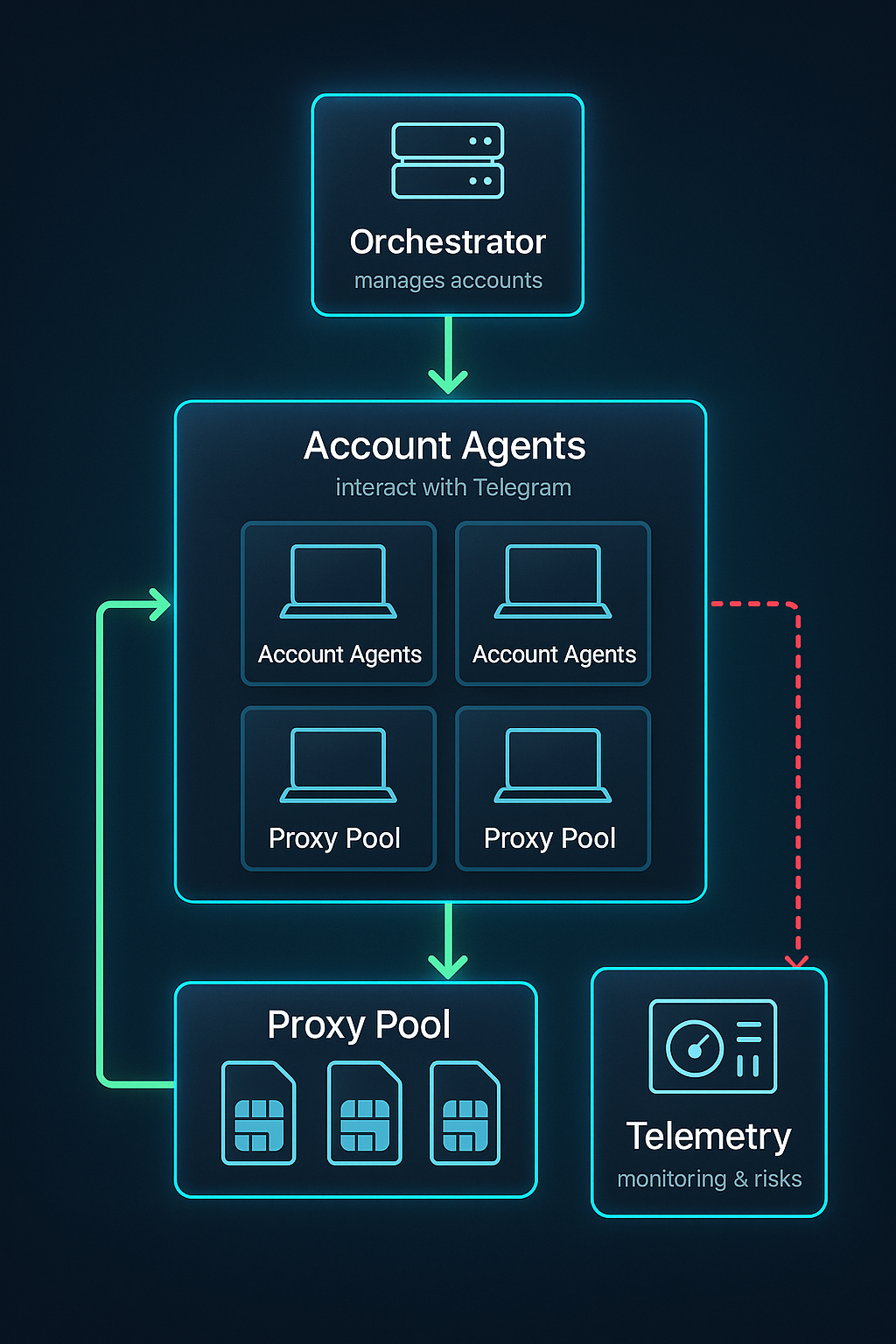
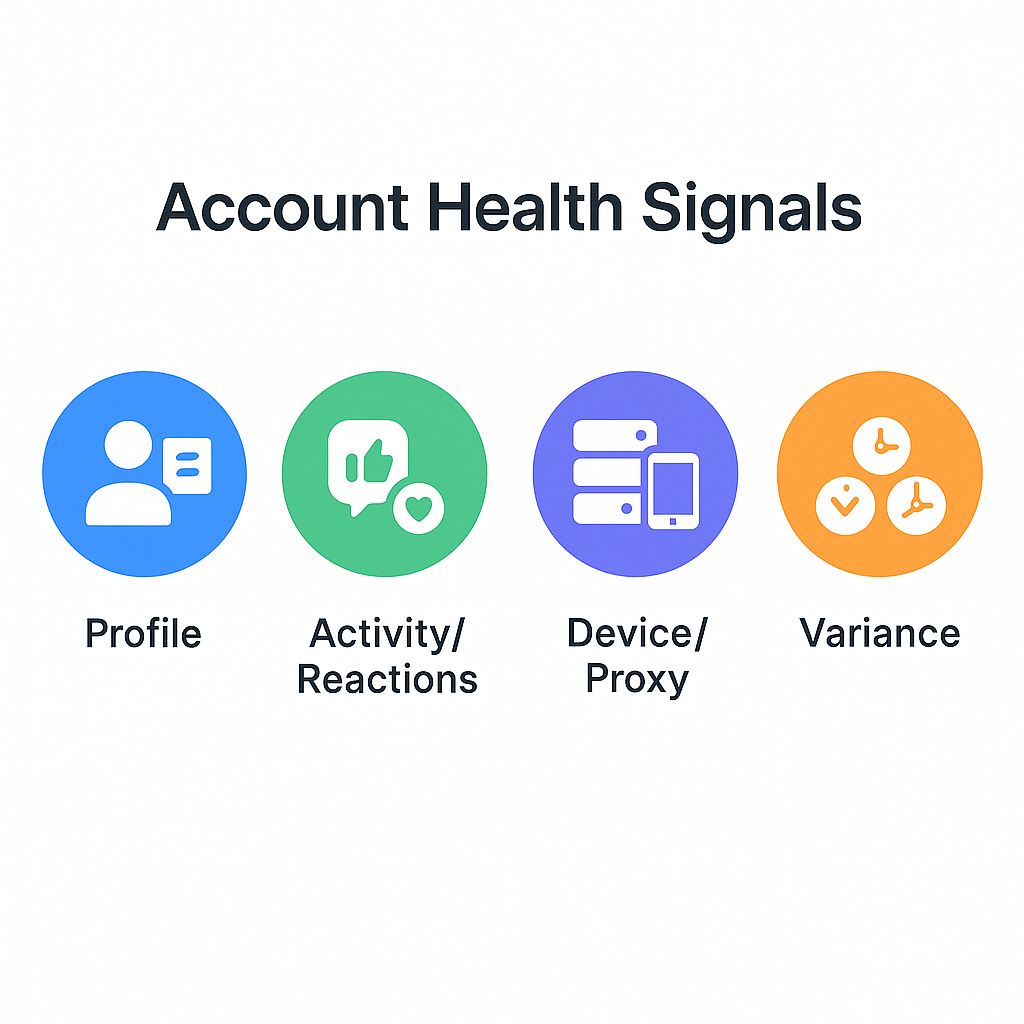
For context, we don't sell accounts. We run campaigns — Telegram mass DM and channel ranking work primarily — that consume accounts as an operational input. The internal pipeline is the answer to the question this article keeps asking: what survives a campaign. We source aged PVA in small batches from two vetted providers, run a 5-day passive warm-up on a dedicated proxy each, score every account on the six-signal health rubric pictured above before it enters production, and rotate any account flagged on more than two signals back into a cool-down pool. The replacement-rate target is under 8% across a 30-day window. The result is that clients who'd otherwise be buying accounts at $5 each and burning through them in a week pay our campaign rate and see the work delivered. If you're researching this market because you have an outcome to hit and not a hobby to run, this is the path most of our clients picked.
If the do-it-yourself angle is what you're here for, the operational pieces in the rest of this site cover the inputs: the member adder tool we use is the same tool the account pool ultimately runs through, the group scraper is what builds the target lists those accounts message, and the channel member-quality piece covers why a well-built pool of 5,000 outperforms a bought number of 50,000 every time. The pages link to each other because the workflow links to itself. None of these tools work in isolation.
Sources
- Telegram Terms of Service — prohibits buying, selling, or transferring accounts.
- Telegram Spam FAQ — describes how reported accounts are limited, first temporarily and then permanently.
- Telegram FAQ — covers account-creation and recovery mechanics referenced throughout the article.
Frequently asked questions
What does "bulk" mean when buying Telegram accounts?
In the marketplace, bulk usually starts at 10 accounts and runs up to a few thousand per order. The unit price drops as the order size goes up — most vendors price in tiers (10, 50, 100, 500, 1000+), each tier roughly 10% to 30% cheaper per account than the one below. There's no formal definition of bulk, but anything under 10 is treated as single-unit pricing.
PVA vs aged Telegram accounts — which is better for bulk?
Aged accounts outperform fresh PVA on almost every metric except sticker price. Survival rate across a 14-day campaign sits at 75–85% for aged versus 20–40% for fresh PVA under the same load. The cost differential gets smaller once you factor in replacements. For anything beyond a single throwaway burst, aged is the operationally cheaper option even though the listing price is many times higher.
Is it legal to buy bulk Telegram accounts?
Buying the accounts isn't illegal in most jurisdictions, but it does violate Telegram's Terms of Service, which prohibit account transfer. The legal exposure shifts based on what you do with the accounts. Marketing automation, scraping public data, or member adding sit in a gray zone Telegram polices through restrictions rather than law enforcement. Spam, fraud, or impersonation crosses into real legal territory, and the platform cooperates with authorities on those.
How much do bulk Telegram accounts cost in 2026?
Fresh PVA ranges from $0.20 to $1 per account in 1,000-unit lots; aged accounts run $3 to $15 depending on age and country of origin. Session-string accounts cost $0.30 to $2; TDATA accounts $0.50 to $3. Country premiums matter — US and UK accounts often carry a 50% to 100% markup over emerging-market accounts of the same age. Vendors usually post tiered bulk pricing on the catalog page directly.
Will Telegram ban accounts I bought in bulk?
Not for being bought — Telegram has no reliable way to detect a transfer at the moment of handover. Bans come from the behaviour pattern after the transfer: shared proxies, high velocity, repeated messages, anomalous geographic logins. Aged accounts get more behavioural headroom, but no format is immune. The single biggest reduction in ban rate comes from proxy isolation and warm-up, not from buying a more expensive account.
Should I buy bulk Telegram accounts or use a bulk Telegram account creator?
For operators running fewer than 500 accounts on short campaigns, buying is faster and the up-front cost is usually lower. For ongoing operations needing thousands of accounts and tighter provenance control, running your own bulk Telegram account creator (Tele Diamond, ONE DASH, or open-source scripts plus an SMS-API provider like 5sim) pays back within a few thousand accounts. The break-even depends mostly on your SMS-API rate and how much operator time you can assign to it.
What's the safest way to use bulk Telegram accounts after buying them?
Three rules in order: one residential or mobile proxy per account with geo consistency to the registration country, a 5- to 14-day passive warm-up before any outbound action, and a sending cap that respects each account's trust-band ceiling for the day. Above those, pool rotation matters — never push the same account through two campaigns back-to-back. We bake all of this into the YourSolutions mass DM workflow because it's the only setup that lasts.