A Telegram account creator bot is software that registers new Telegram accounts at scale — usually by chaining an emulator or browser instance, an SMS verification API like 5SIM or SMS-Activate, and a proxy per session. Four operating modes exist: open-source emulator scripts, anti-detect browser farms, fully managed creation services, and the buy-pre-made-accounts path. Each trades cost, control, and ban-risk differently, and the right one depends on the campaign size and the burn rate you can absorb.
Most articles treat "telegram account creator bot" as a single category — one type of tool, ten different brand names. That framing is wrong, and it is the reason so many first campaigns burn budget before they send a message. There are at least four meaningfully different builds wearing the same label, and they fail in completely different ways. Pick the wrong one and you are not buying accounts, you are buying a 48-hour ban delay.
We operate a managed sender pool for client campaigns (it sits behind the same infrastructure as our Telegram mass DM service), which means we have run, broken, and replaced bulk-creation pipelines for years. This guide is the categorical breakdown that I wish someone had handed me in 2022: the four real modes, the actual numbers attached to each, what the popular tools do under the hood, and the decision tree that sends you to the right answer.
Need bulk Telegram accounts that survive past day three?
What is a Telegram account creator bot?
A Telegram account creator bot is automation software that registers new Telegram accounts on demand. The label covers four meaningfully different builds — a Python or Go script driving an Android emulator like BlueStacks or MEmu, an anti-detect browser farm running Telegram Web in isolated profiles, a managed service where someone else operates the same stack for you, and the side-step of buying pre-made accounts entirely. All four end at the same place: a working session file or tdata bundle that another tool — a member adder, a bulk DM sender, a scraper — can drive. The differences live upstream, in how the registration is performed, on whose phone numbers, behind which proxies, and against Telegram's 2026 anti-spam fingerprint. Picking the wrong mode is the cheapest way to burn a budget on accounts that are dead inside two days.
The vocabulary in this corner of the SERP is loose. People type telegram account creator, telegram account creator bot, bulk telegram account creator, or telegram bulk account creator and end up on tool landing pages, GitHub repos, and reseller storefronts that are doing categorically different things under the same umbrella. Worth being precise: a "creator" makes new accounts. A "buyer" purchases existing ones. A "manager" rotates between accounts you already have. They feed each other but they are not the same product.
The four modes: emulator scripts, anti-detect browsers, managed creation, pre-made accounts
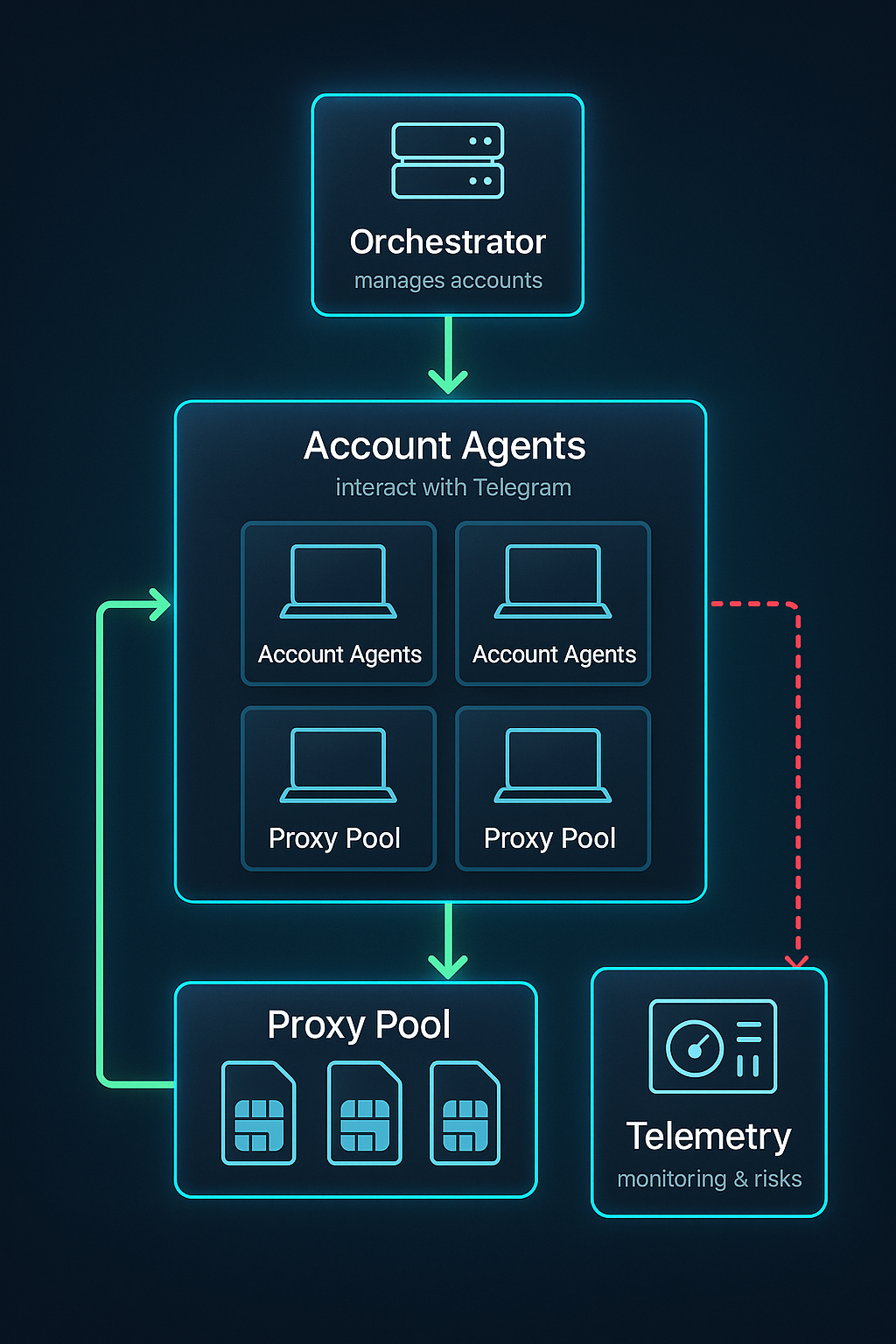
Strip away the marketing and four operating models account for almost every tool sold under the telegram account creator bot label. Mode one is open-source emulator scripts — KenzaByte's Telegram-Bulk-Account-Creator-Emulator, emonahmmed's Python build, the celestix AccountGeneratorBot. They drive BlueStacks or MEmu, pull numbers from 5SIM or SMS-Activate, and dump session files at the end. Mode two is anti-detect browsers — Multilogin, GoLogin, GeeLark, Pixelscan — running Telegram Web inside isolated browser fingerprints, often paired with cloud Android phones for the OTP step. Mode three is managed creation, where a seller operates a fleet of warmed accounts and ships you sessions or tdata bundles on demand. Mode four is the bypass route: buy pre-made aged accounts and skip creation entirely. Each mode answers a different version of the same question, and the right one depends on whether you need 50 accounts for one campaign or 5,000 a month at steady cadence.
The categorical mistake worth flagging up front: people compare a $50 emulator script to a $400 anti-detect browser to a $0.40-per-account managed seller and conclude one is "better." That comparison is meaningless because they solve different problems. The script is cheap because you operate it; the browser farm is expensive because it parallelizes cleanly across boxes; the managed seller is priced because someone else absorbs the warm-up time and the soft-ban cycles. The right unit of comparison is cost per surviving account at the volume you actually need — and that number rearranges the rankings completely.
How a telegram account creator bot actually works under the hood
The registration loop is roughly identical across every DIY telegram account creator and is worth understanding even if you never touch the code. The bot reserves a phone number from an integrated SMS provider, spins up an emulator instance (or a fresh browser profile) on its assigned proxy, opens Telegram, types the number, waits for the verification code to land in the SMS provider's API, fetches it, types it into the OTP field, completes the profile setup with a pre-canned name and avatar, exports the resulting session file or tdata bundle, and tears the emulator down. The good builds parallelize this across many emulator instances at once and rotate proxies aggressively between every registration; the bad ones run a single thread and reuse the same IP across dozens of registrations until Telegram notices the cluster and limits the whole batch retroactively.
February 2023 was the cutoff. Before then, you could register Telegram accounts directly through the MTProto API with no UI involvement — cheap, fast, and abused at scale. Telegram closed that door, which is why every modern creator now uses an emulator or browser to reproduce a real device fingerprint during signup. The 2026 detection layer goes further: Telegram cross-references the carrier behind the SIM number, the geolocation of the IP, the device fingerprint of the emulator (BlueStacks default profiles are well-known to the platform), and the timing micro-patterns of the registration flow. Mismatch any two and the account is shadow-flagged before it has done anything.
One detail people skip: the SMS provider matters more than the bot does. 5SIM and SMS-Activate sell numbers from carrier ranges that Telegram has spent years cataloguing. Some country ranges are on a soft blacklist (registration succeeds but the account is ghosted within hours). Others are clean for weeks. Operators rotate countries the way DJs rotate records, and the smart ones do not advertise which ones are working that month.
What does a bulk telegram account creator cost per surviving account?
The headline numbers from the SMS providers are the easy part. Telegram numbers on 5SIM run $0.10 to $0.11 each depending on country, and SMS-Activate sits around $0.17 per number. Multiply by your batch size and you have the SMS bill. That is the floor, not the price — and it is the only number every comparison post quotes, which is why their math is broken. The real number is cost per surviving account, and it depends on a survival rate that nobody publishes because admitting it would scare off buyers. Across our internal pool builds in 2025 and early 2026, commodity 5SIM numbers on residential proxies showed roughly 50 to 70 percent first-week survival when paired with sensible warm-up. Drop the proxy quality or rush the warm-up and that drops to 20 to 30 percent fast.
| Cost component | Typical price (May 2026) | Notes |
|---|---|---|
| 5SIM virtual number (Telegram) | $0.10 – $0.11 | Country-dependent; some ranges soft-blacklisted |
| SMS-Activate virtual number | ~$0.17 | Slightly older inventory, broader country coverage |
| SMSPVA virtual number | $0.10 – $0.20 | Smaller pool, occasional cleaner carriers |
| Residential proxy slot | $0.10 – $0.30 per account | Amortized; mobile proxies cost 3–5x more |
| Anti-detect browser license | $30 – $200 / month | Multilogin, GoLogin, GeeLark tiers |
| Open-source emulator script | $0 (license) + your time | KenzaByte, emonahmmed, celestix repos |
| Pre-made aged account | $1.50 – $4.00 | 3+ months age, sessions included |
| Managed creation (per surviving) | $0.40 – $0.90 | Survival contractually backed, warm-up included |
Plug those into a 1,000-account batch with the script path: $110 in numbers, $200 in proxies, your time, and a 60 percent survival = roughly $0.52 per surviving account, plus whatever your hours are worth. Same batch through pre-made aged accounts: $1,500 to $4,000 flat, but every single one is alive and warm. The break-even sits somewhere around 500 to 1,500 accounts depending on whether your time is free, and that is exactly why teams shipping campaigns weekly tend to buy bulk Telegram accounts instead of running creation in-house. The math doesn't care about which approach feels more clever.
Ban risk in 2026: why fresh accounts die in 48 hours
Telegram's anti-spam stack has never been static, but the 2026 build is the first one that meaningfully outpaces the cheap creator tools. The official Telegram Spam FAQ spells out the user-facing rules; what it doesn't tell you is what the platform's behavioral models actually look at under the hood. From talking to other operators and watching our own ban-batches cluster in the dashboards, four signals do most of the damage in 2026. Carrier-range fingerprinting kills accounts before they send a single message: 5SIM numbers on certain VoIP-flagged ranges are limited within minutes of registration. IP-to-number geo-mismatch (a Russian number on a US proxy, a Vietnamese number on a UK exit) is the second-most-common cause of death. Device fingerprint reuse from a cookie-cutter emulator profile is third on the list. And session-timing telemetry — how fast you click through onboarding, how long the first message sits before sending — closes the loop quietly.
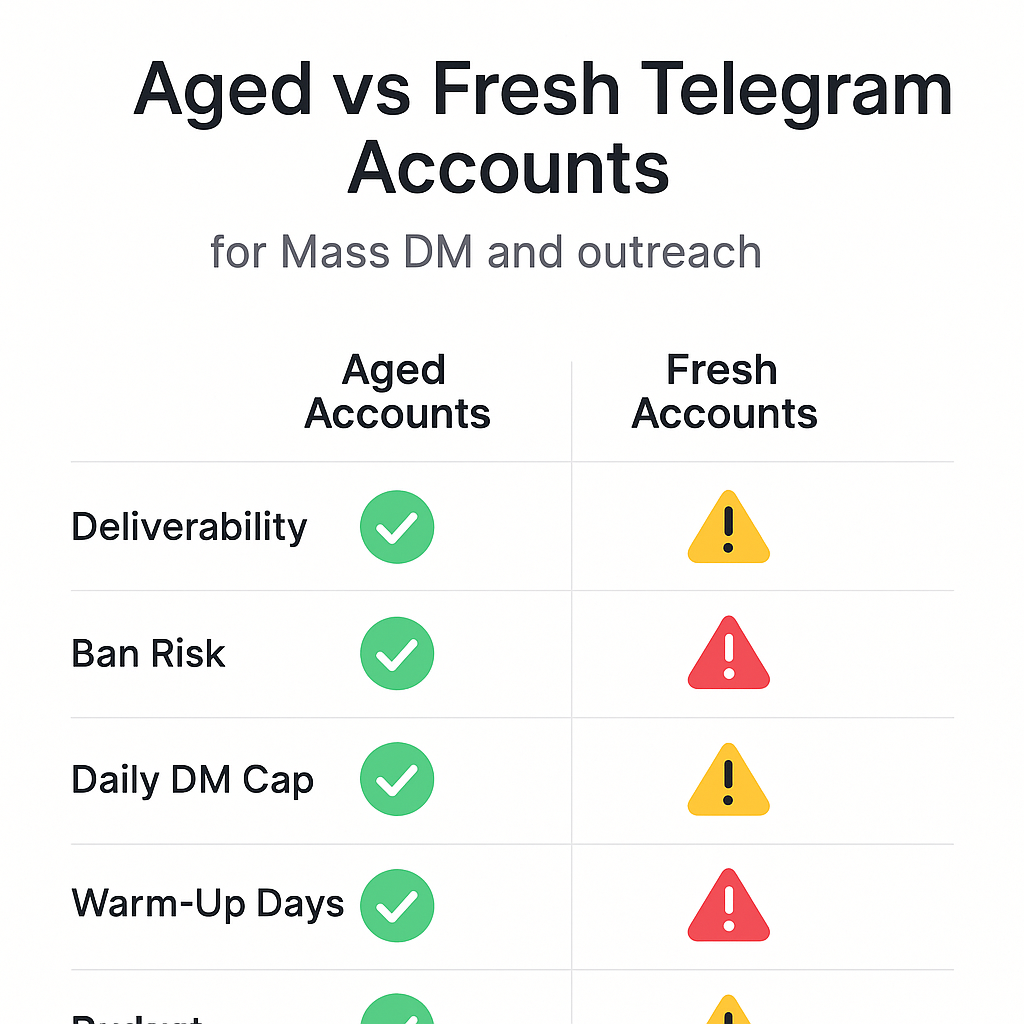
The five rules that survive every campaign post-mortem are not exotic. One: never use a bulk creator's accounts on day one — ship them to a warm-up pool that does light reading, joining, and reacting for at least 5 to 7 days before any outbound action. Two: dedicated proxy per account, always, no exceptions. Same-IP clusters cascade-ban inside hours. Three: rotate the SMS country range monthly because Telegram catalogs them. Four: do not reuse default emulator device IDs — randomize them, or use anti-detect browsers that handle this natively. Five: pace early actions ferociously. A "fresh" account joining 30 groups in its first hour is the textbook signature of automated registration. The platform looks for it because it works.
Two things people get wrong about ban risk. First, the ban does not always come fast — soft-bans (the account works but messages are silently dropped from non-contact inboxes) are now more common than hard-bans, and they are far worse because they are invisible until you measure delivery. Second, account age alone does not save you. A six-month-old account that never logged in is functionally fresh; the platform watches behavior, not just timestamps. This is why aged Telegram accounts sold by serious vendors come with a documented warm-up history, not just a creation date.
Telegram bulk account creator software, compared
Eight of the top ten search results for telegram bulk account creator are tool landing pages or GitHub repos, and the marketing on each insists the tool is uniquely safer or faster than the rest. They are not. The differences are real but much smaller than the copy implies, and the operational discipline around the tool matters far more than the brand on the box. Here is how the most-cited names actually map, sorted by what they really are rather than what they claim. Three categories show up over and over: free open-source scripts that hand you the registration loop and nothing else, paid anti-detect browser farms that handle device fingerprints natively, and aged-account marketplaces or managed pools that bypass creation entirely. The names rotate; the architecture inside each bucket is nearly identical, and so are the failure modes when the tool is run without the surrounding discipline.
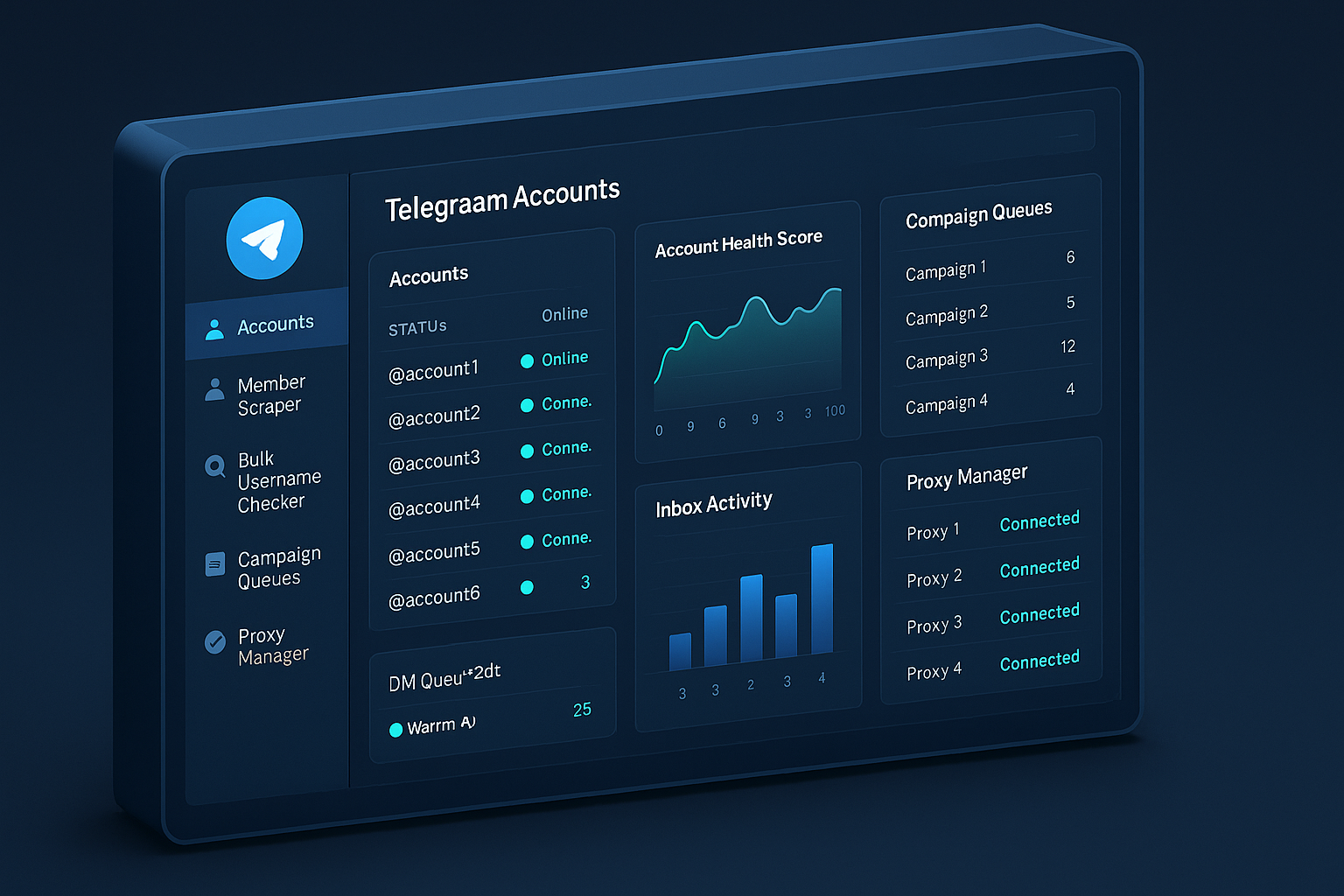
| Tool | Mode | Pricing | Who runs the risk |
|---|---|---|---|
| KenzaByte Telegram-Bulk-Account-Creator-Emulator | Open-source emulator script (Windows + BlueStacks) | ~$50 lifetime / GitHub free fork | You operate, you eat the bans |
| emonahmmed telegram-bulk-account-creator | Python script + 5SIM API | Free (GitHub) | You operate, you eat the bans |
| celestix AccountGeneratorBot | Go-based emulator script | Free (GitHub) | You operate |
| Multilogin / GoLogin | Anti-detect browser farm | $99 – $199 / month | You operate, fingerprints handled for you |
| GeeLark | Cloud Android phone fleet | $30+ / month per device | You operate, real-device fingerprints |
| QniBot / TheCoder bulk creator | Hosted creation tool | Per-account or subscription | Mostly you, infrastructure abstracted |
| Aged-account marketplaces | Pre-made accounts (no creation) | $1.50 – $4 per account | Seller absorbed all creation risk |
| YourSolutions managed pool | Managed creation + warm-up | Scoped per campaign | We absorb creation, warm-up, replacement |
One pattern is worth naming. Every script and browser-based tool puts the survival problem on you. That is not a flaw — it is the deal. You get cheaper unit economics and full control over the pipeline; you also own every banned account and every misconfigured proxy. The tools that abstract away the operational layer (managed sellers, pre-made marketplaces) cost more per account but ship you working sessions, which is the only metric a campaign cares about. The intermediate options — QniBot, TheCoder, and similar — sit in an awkward middle where you are paying for hosting but still owning the policy decisions. They are fine for small batches and frustrating at scale.
Build vs buy: when to skip telegram account creation entirely
The build-versus-buy decision for Telegram accounts collapses to three honest questions. First: how many surviving accounts do you actually need per month? Second: do you have someone who can run proxy and SMS plumbing without it eating their week? Third: what is your tolerance for soft-bans showing up mid-campaign? Answer those and the right path falls out. A team needing 50 to 200 accounts a month for one-off campaigns is well-served by an open-source script, $20 in 5SIM credit, a residential proxy subscription, and a willingness to lose some inventory while learning. A team running weekly outbound at 1,000+ surviving accounts is going to lose more in burned numbers and operator time than a managed pool would charge. And a team that needs accounts in 24 hours for a launch should just buy pre-made aged accounts — the cost is a rounding error against the campaign value at that timeline.
The under-discussed alternative is to question whether you need bulk creation at all. A lot of campaigns reach for telegram account creator bot first when the actual need is somewhere else. If the goal is reaching strangers via DM, the accounts are a means — what you really need is the full pipeline, which our Telegram bulk message sender writeup covers in operational detail. If the goal is adding members to your channel, that is a member-adder problem and accounts are inputs to a Telegram member adder tool, not the deliverable. If the goal is more channel subscribers organically, you may be better off improving your channel's in-app search ranking so it surfaces without per-send risk at all. The accounts are infrastructure; ask what they are infrastructure for.
Pairing accounts with the rest of the stack
Bulk-created Telegram accounts are not a finished product on their own. They are inputs to whichever automation actually does the work, and the failure mode most teams hit is putting good fresh accounts behind a sloppy execution layer. A 500-account pool driven by a tool that ignores per-account pacing will burn the entire batch inside a week regardless of how clean the registration phase was. The accounts and the runner have to be tuned together — same proxy assignments end-to-end, same per-account delays, same content variation, same warm-up history feeding the same outbound cadence. Treat the creation phase as one quarter of the project; the other three quarters live in scraping the right list, pacing the sends, varying every message body, and reading the early ban-signal patterns from Telegram so you can back off cleanly before soft-limits cluster across the pool.
A few specific stack pairings come up constantly. Cold outreach campaigns pair created accounts with a Telegram group scraper for sourcing and a paced sender for delivery; the accounts are the consumable in the middle. Channel growth campaigns pair them with a member-adder tool that respects daily caps. Vertical use cases — OnlyFans Telegram promotion in particular — layer per-niche targeting and warm-up scripts on top of the same account stack. And the broader Telegram automation field guide covers how Bot API and userbot layers compose with these account pools when the campaign needs both. None of those pairings is exotic. They are just disciplined about treating accounts as the substrate, not the strategy.
FAQ
What is a Telegram account creator bot?
A Telegram account creator bot is automation software that registers new Telegram accounts at scale. It chains an emulator or anti-detect browser, an SMS verification API like 5SIM or SMS-Activate, and a proxy per session, then exports the result as a session file or tdata bundle. Four broad builds exist — open-source emulator scripts, anti-detect browser farms, managed creation services, and the pre-made account bypass — and they trade cost, control, and ban-risk very differently.
Is using a bulk Telegram account creator legal?
The tool itself is legal in most jurisdictions, but Telegram's terms of service prohibit creating, buying, selling, or operating accounts not registered by the actual end user, especially for commercial, bulk, or automation use beyond personal limits. Violating those terms results in account bans, not legal action against you. The risk is operational, not criminal — except in places like the UK or France where mass automated account creation can intersect with anti-spam or computer-misuse statutes if used aggressively.
How fast can a telegram account creator generate accounts?
Roughly 100 to 200 accounts per hour with a multi-instance emulator setup on a single workstation, assuming SMS numbers are available and proxies do not bottleneck. Anti-detect browser farms run slower per box but parallelize across cloud infrastructure cleanly. The throughput number is misleading by itself — what matters is how many of those accounts are still alive 72 hours later, and that drops fast on shared IPs or VoIP-flagged numbers.
What does a single Telegram account cost to create with 5SIM or SMS-Activate?
Telegram numbers on 5SIM start around $0.10 to $0.11 each depending on country availability, and SMS-Activate sits around $0.17 per number. Add a residential proxy slot (about $0.10 to $0.30 amortized per account on a small subscription), the tool license if you bought one, and the survival rate. With a typical 50 to 70 percent first-week survival on commodity numbers, the real cost per surviving account lands closer to $0.30 to $0.60.
Will Telegram ban accounts created in bulk?
Often, yes — the question is when, not if. Telegram's 2026 anti-spam stack flags VoIP and SMS-relay number ranges before the first send, watches for IP and geolocation mismatches, and times micro-behavioral patterns inside sessions. Fresh accounts on shared IPs sending cold DMs typically die inside 48 hours. Aged accounts on dedicated proxies, with paced behavior and warm-up activity, survive long enough to run a real campaign.
Should you build a telegram account creator or buy pre-made accounts?
Build when you need 50 to 200 accounts a month and have someone who can run the proxy and SMS plumbing. Buy pre-made aged accounts when you need volume immediately, when warm-up time matters more than per-account cost, or when you have already lost a batch to early-stage bans. The break-even sits around 500 surviving accounts per month — below that, sourcing is cheaper than running infrastructure.
Sources
- Telegram Bots FAQ — official platform documentation on Bot API capabilities and limits.
- Telegram Spam FAQ — what triggers spam flags, soft-limits, and account bans.
- 5SIM Prices — live per-country pricing for SMS verification numbers, including Telegram.